|
|||||



|
|
|||||||||||

 |
|
|||
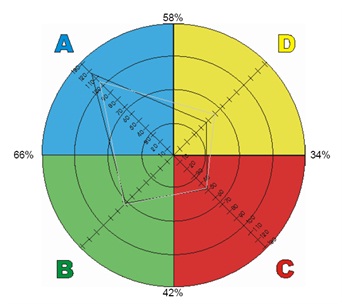
This insight struck home, especially as I see this almost constantly in my Coaching and Leadership Development work with senior executives. Many, if not most managers, are left brained; number focused, cost conscious, bottom line obsessed, worshipping the ‘faithful servant’ managers. Their worship has served them well. Many oversee departments or command divisions, even companies. And yet, in spite of their visible success, many are seeking... Executives, some openly and some under a little persistent prying, do shed their veil of certainty and share their doubts about their onward journey. They are seeking the gift that they have forgotten. They realize at a fundamental level that “what got them here, won’t get them there” as Marshall Goldsmith put it so well. Typically a senior manager, in my experience would have a “Herrmann Brain Dominance Profile” (HBDI®) profile that resembles the one below. This double dominant profile is one of the most common profiles - about 19% of over the two million profiles featuring in the Herrmann Database: Fig 1:
Briefly, each of the quadrants signifies a mindset; the blue quadrant is rational – objective, analytical. The green quadrant is about process, attention to details and avoidance of risk. The red quadrant is about emotion- trust, collaboration and a focus on people. The yellow quadrant is about the future- strategic thinking, experimentation and taking risk. We are a combination of all these four different ‘selves’ or mindsets. We all have a unique profile - the way we think - with dominance in certain quadrants. The important point here is that the sooner we become aware of the way we think - the sooner we would be able to recognize and mitigate the consequences of the way we think in different situations. Together ‘A-B’ quadrants constitute left brain thinking. Left brain thinking is about narrow sharply focused attention to details. Managers, who are more left brained see things in a more concrete way, pursue defined goals, measure progress and are articulate. Their focus is on facts, constructs based on data and not so much on the individual. On the other hand, the ‘C-D’ quadrants constitute right brain thinking - and those who are more right brained demonstrate a sustained, broad, vigilant alertness - a focus on the bigger picture. Managers who are more right brained, focus more on the individual than a category; see the world as evolving, changing, interconnected and are able to interpret situations in context. It is this perspective that I find largely missing when I coach successful managers typified by the profile in fig. 1. The Right Brain coaching conversation The coaching conversations that I have with leaders, seeks to explore the power of the ‘C-D’ quadrant thinking and what this would mean for leaders in their context. The budgeting exercise for a CFO was a period of stress for his team; he set targets, planned well and laid down detailed guidelines for his team to follow. Every year the result was similar, the quality of output was average at best, rework was the norm and in the end while the task got done, no one was really happy with the overall outcome. When we discussed this, one of the approaches that we explored was whether he felt the need to explain the situation to his team - communicate the implications, his concerns and his vision of what the budget would achieve. He was quiet and told me that while he took pride in his precise instructions and detailed planning, he had never really considered the possibility of listening to his team rather than telling and involving them as individuals in the task on hand. To his credit, he changed his leadership style and found that the energy levels of the team as well as the ownership of the task substantially increased. More importantly, the budgeting exercise was completed within the deadline with minimum follow up and the quality of the work was superior. The awareness of his thinking preference helped him understand the need for him to make the shift to a different way of managing and leading. There is a problem with the nature of the two worlds defined by the Right and Left Brain. Reason cannot exist without intuition and the challenge today for leaders is to be ‘whole brained’ as much as possible in any situation. I believe, to succeed today, leaders need to pass the Scott Fitzgerald test: “The test of a first-rate intelligence is the ability to hold two opposed ideas in mind at the same time and still retain the ability to function.“ The servant must use the gift well! |
||||



 |
|
||
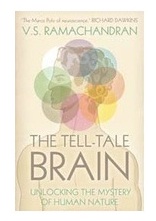 V. S. Ramachandran, a professor of neuroscience and psychology at the University of California, San Diego, has done as much as anyone to reveal the workings of the mind through the malfunctions of the brain. ‘The Tell-Tale Brain’ is a general tour of neuroscience. Ramachandran reveals how the human brain has evolved unique functions that separate us from other primates. He proposes that around 150,000 years ago our brain started to change, allowing us to learn to perform new tasks. “All the same old parts were there,” he writes, “but they started working together in ways that were far more than the sum of their parts,” giving humans distinctive traits, such as language, empathy and morality. He does so by gleaning insights from rare and intriguing neurological disorders such as the Cotard syndrome or ‘Walking corpse syndrome’ a rare neuropsychiatric disorder in which people hold the delusional belief that they are dead. He also looks at Capgras syndrome (when a person believes those around him have been replaced by imposters), apraxia (when a person cannot mimic simple gestures) and telephone syndrome (when a person is comatose but can somehow converse on the phone). He has a fondness for evolutionary explanations that are really interesting. For example, he relates the colour-matching of clothing and accessories to the experiences of our ancestors when they spotted a lion in the undergrowth by realizing that those yellow patches in between the leaves are parts of a single dangerous object. Ramachandran’s main thesis, however is that networks of brain cells known as mirror neurons, which were discovered in monkeys in the late 1990s, have played a uniquely important role in human evolution. These cells appear to become active in a creature’s brain not only when certain actions are performed by the creature itself but also when the creature observes its fellows performing the same actions. Ramachandran believes that mirror neurons somehow enable us to understand the minds of others, to learn by imitation and to feel empathy, and are perhaps involved in self-awareness. Some dramatic surge in the development of mirror neurons, he argues, explains the birth of distinctively human mental abilities and culture about 150,000 years ago. Based on this theory, he suggests that the Cotard syndrome may result from damage to mirror neuron circuits, causing a person to lose that self-awareness. Such bold leaps may make some scientists uneasy, but they are also what make Ramachandran so provocative and his book such an entertaining read. | |||
|
|||
 Sshrishti means creation. In 2003 with a mission to create a better tomorrow for the children living in the slums and remote impoverished villages of India, Sshrishti was incepted by its founder - Sanghamitra Bose. She started by teaching a few children from a nearby slum and from there the initiative continued to grow. To redress the inequality that exists in society, Sshrishti started offering personalized and quality educational facilities to the underprivileged children. Special emphasis was given to teachingEnglish and computers to the children. Realizing that hungry children do not make attentive students, Sshrishti soon introduced a mid-day meal for the children.Sshrishti was registered as a trust in December 2003 and is run by a duly elected Governing Body. Today, in less than eight years of its formal existence, Sshrishti has four learning centers in Delhi and one in NOIDA, UP. Sshrishti offers counseling to the community on the importance of education, enrolls children to its centers, offering primary schooling, milk in the morning, a-mid day meal, annual health check-up and extracurricular activities. The NOIDA center offers schooling from nursery to class X to the girls of the Geja village. Sshrishti’s centers are full of happy faces of children, enjoying their childhood and looking ahead to a future. After completing basic primary education, Sshrishti enrolls children into the government schools and monitors their progress. By offering remedial classes to help the children with their school work, efforts are made to prevent the children from dropping out of the education system. In the five centers covering Delhi and NCR, Sshrishti offers education to nearly 750 children. |
|||
|
To bridge the digital divide and bring the children from the villages into the technology driven society, Sshrishti's Rural Computer program runs six centers in North India bringing e-learning to the lives of 2,000 children. It is the dream to ‘create a modern, literate India’ that drives team Sshristi to go the extra mile.
In 2010 Sshrishti was honored with the best NGO Award in Northern India (Category - small) by Resource Alliance and Rockefeller Foundation. For the unflinching benign efforts that Ssrishtistands for, it deserves a Standing Ovation! If you want to get more information and supportSsrishti,you can visit its website www.sshrishti.org or look up their Facebook page http://www.facebook.com/group.php?gid=44727418102&ref=ts#. | |||

|
||
|
