
| November 2014 |
    |
| Thinking Aloud | Podium | We Recommend | Standing Ovation |
| Faculty Excellence in Academics - Vijayan | Interview with Dr. Jagdish Sheth - Charles H. Kellstadt Chair of Marketing, Goizueta Business School of Emory University | The Accidental Scholar – By Dr. Jagdish Sheth | Saath - Ahmedabad, Gujarat |
|
Dear Reader, Indian history echoes the importance of gurus or teachers who have played a pivotal role in the days gone by and their role seems even more unabated and important in the changing and challenging times that we live in today. To make Indian universities some of the best in the world, faculty members in academia must be equipped to take on the changing attitudes and learning processes of students. Moreover, classrooms today are not confined to the four walls of a room, but have been transformed to digital or smart classrooms which engulf not only a large number of students, but also one which is diverse. Proper selection, training and preparation of academic faculty will help ride over the future challenges that may crop up. It would also help if faculty today could explore and step out of the comfort of traditional methods of teaching and try to establish linkages and centres of excellences to connect industry and academia to advance education, research and outreach in key areas, which are also critical to emerging economies such as India. On that note, the theme for ET this month is faculty excellence in academia. In Thinking Aloud, Vijayan looks at the various facets of an ideal faculty in today’s education system. Although the concept of an ‘excellent faculty’ is not very customary in the Indian landscape, this view is slowly changing. Likewise, students have also changed with reference to their approach to learning. Therefore, today it is essential that faculty in the academic realm have to constantly re-invent themselves to cope up with students' learning preferences and their expectations. Vijayan has also put forth his views of how faculty can enhance their excellence levels. On the Podium, world renowned educationist, Dr. Jagdish Sheth tells readers why his life story is characterised as an ‘Accidental Scholar’. He goes further on to tell us that senior professors in the Indian academic world must get actively involved in academic societies outside India, apart from being a knowledge disseminator, a researcher and a lead fundraiser. Dr. Sheth elucidates three disruptive trends in the field of education and talks about unfulfilled tasks in his life. | |
|
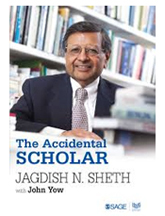
In the We Recommend section, we present Dr. Jagdish Sheth’s book 'The Accidental Scholar'. The book reveres Gurus or Teachers and is an autobiography of Dr. Sheth’s fascinating journey and the many interesting encounters and opportunities that came along the way, that shaped his path to success. Dr. Sheth did not confine himself to fate, but his curiosity coupled with his keen sense of exploration to gather local inputs, helped him to break ground and predict trends in academia and geopolitics. In his stints at many universities, the book illustrates his role as an institution maker, while maintaining his chosen role as a scholar & teacher.
In Standing Ovation, we feature Saath, an NGO in Gujarat. Saath utilizes market-based strategies to create inclusive societies by empowering India’s urban and rural poor. It pioneered the integrated slum development programme in 1989, an approach that seeks to turn slums into vibrant neighbourhoods. Since the poor often have many needs at once, Saath has created one-stop centres enabling a link with Saath’s integrated programs in education, job training and placement, medical and legal services and basic infrastructure. Poor communities co-invest with Saath and donors by paying for, deciding and implementing Saath’s programmes. In Figures of Speech, Vikram’s learning curve has a two way message! As always, we value your opinion, so do let us know how you liked this issue. To visit our previous issues you can visit the Resources section on the website or simply Click Here. You can also follow us on Facebook, Twitter, Linked In & Google+ - where you can join our community to continue the dialogue with us! | |


 |
We Recommend The Accidental Scholar - Dr. Jagdish Sheth |
 'If you take a grain of wheat and make it a loaf of bread, the value add is about three times. If a diamond cutter takes a rough diamond and polishes it, the value add is probably 15 to 20 times. However, if you take a human being and educate and mentor him/her, the value add is infinite'. (From 'The Accidental Scholar')
In ancient India, the Guru or Teacher was a noble soul. In a society where knowledge is supreme, a teacher is the revered one, for he showed you the path of learning and walking this elevated path was considered the righteous road to glory. It is said that in every regal court in days past, while the Prime Minister would be the head of the executive machinery carrying out the decisions of the King, the one who truly had the King’s ear was his Guru. Not just a counselor or a Trusted Advisor, the Guru also was a conscience keeper to whom the King turned to when any vexed question of State, or even a personal dilemma, arose. However, over time, with the rise of the material world, the role of such wise Gurus has abated. Or, perhaps it is that such wise men are difficult to find! 'If you take a grain of wheat and make it a loaf of bread, the value add is about three times. If a diamond cutter takes a rough diamond and polishes it, the value add is probably 15 to 20 times. However, if you take a human being and educate and mentor him/her, the value add is infinite'. (From 'The Accidental Scholar')
In ancient India, the Guru or Teacher was a noble soul. In a society where knowledge is supreme, a teacher is the revered one, for he showed you the path of learning and walking this elevated path was considered the righteous road to glory. It is said that in every regal court in days past, while the Prime Minister would be the head of the executive machinery carrying out the decisions of the King, the one who truly had the King’s ear was his Guru. Not just a counselor or a Trusted Advisor, the Guru also was a conscience keeper to whom the King turned to when any vexed question of State, or even a personal dilemma, arose. However, over time, with the rise of the material world, the role of such wise Gurus has abated. Or, perhaps it is that such wise men are difficult to find!
Dr. Jagdish Sheth is, in a sense, part of this diminishing tribe of wise men. His autobiography, ‘The Accidental Scholar’ is a candid narration of how his life was shaped & enriched by events, people and opportunities that happened to him not so much by design but by being open to the flow of life. However, to attribute all the good fortune in his life as being a quirk of fate does not do justice to someone who worked his way up in life fighting many adversities, not just by dint of his natural talent but also by pushing himself to taking risks by questioning the obvious. Whether it is the events leading up to the collaborative work with his mentor, Prof. John Howard (leading to the seminal Howard Sheth Model in Consumer Behavior) or exploring new opportunities by returning to India in the 1960s to teach at IIM, Kolkata, or teaching stints at Singapore (at the NUS) and in Denmark (at the Copenhagen School of Business), Dr. Sheth has not hesitated to break new ground in transferring knowledge to new geographies & also by staying curious, used his keen sense of exploration to gather local inputs, and then connected the dots to predict trends in academia and geopolitics. This makes him a rare individual who is able to straddle multiple fields of knowledge and see the linkages & thereafter interpret it in simple terms to his audience, be it students & academics, business managers or policy makers. An example of this is the work that he initiated at the India, China & America Institute (ICA Institute), which he founded at Atlanta as early as 2003. Drawing on talent from these nations, he is able to see common ground, where others see diversity, as witnessed in his work in ‘Chindia Rising’. Dr. Sheth’s book also illustrates his role as an Institution maker. In his long stints at multiple American Universities (Pittsburgh, Columbia, MIT, Southern California, and now at Emory University), he has played the leadership role in attracting & choosing some of the best minds in their field to come & create research-based inputs and teach them to students from across the world. Dr. Sheth maintains that his chosen role is to be a scholar & teacher, and in his words, ‘making ordinary people extraordinary is probably the greatest purpose of life’. Apart from having guided numerous Ph.D. students, and being a prolific author (scores of ground-breaking books and academic articles), Dr. Sheth has created many world-class research institutions. Besides, with the active support of his wife, Madhu (who Dr. Sheth calls the ‘love of my life’), the Sheths have lived by their philosophy of ‘the more you accumulate, the more you must give back’ and have created the Sheth Foundation, and other bodies, to fund many ventures that have helped students, academic organizations and other resident scholars to pursue the path of academic excellence. His academic peers have admired Dr. Sheth’s life journey more than anyone else. Philip Kotler calls him an inveterate learner, a peripatetic scholar and a Renaissance Man, considering Dr. Sheth’s breadth: ‘from accounting to manufacturing to consumer behavior, to social psychology, then moving to strategic marketing to multivariate statistics, then into international marketing, and business policy.’ All this and more, given that Dr. Sheth has played an active role as Board Member to various global corporations and Think Tanks. What does it take to be a genuine world class Thought Leader? To the curious, I would highly recommend this book, and especially for all who wish to think unfettered and want to achieve more in their life. Dr. Sheth’s story is an inspirational tale of what can be achieved when one dreams big and works towards these goals. And, with humility, Dr. Sheth states that ‘without education and mentorship, I would not have reached my full potential and, neither would have those whose lives that I have had the privilege to touch.’ At 75, Dr. Sheth continues to travel intensely and gives his time generously to others. Given his restless and fertile mind, one suspects that there is a sequel in the works to continue the story of this unique ‘deep generalist’. |
 |
Standing Ovation Saath - Ahmedabad, Gujarat |
|
Mission: To make human settlements an equitable living environment, where all residents and vulnerable people have access to basic needs for development like health, education, essential infrastructure services and livelihood options, irrespective of their economic and social status. Objectives
Since 2007, Saath’s focus has been to strengthen the community, to build up leadership skills and for the overall development of the community. The new approach of Saath for the coming years is to work for vulnerable youth and women of the society. The organisation will also work for the betterment of vulnerable people by reaching out to the people at the grass root level. Main Programs along with other initiatives include
While Saath invests in human capacity of persons to manage its programmes in their communities, these communities co-invest with Saath in turn. Saath engages institutions, corporates and individuals throughout the world as partners and supporters of its integrated development in India. During the financial year 2013-14, Saath created an impactful change especially in the states of Gujarat and Rajasthan, reaching out to 4,60,576 individuals and their respective families. For more information, about Saath, one can visit http://www.saath.org For its efforts, Saath deserves a standing ovation! |
|
 Founded in 1989, Saath is actively involved in activities related to health, education, savings and credit. In the same year, Saath pioneered the Integrated Community Development Programme, an approach that sought to turn slums into vibrant neighbourhoods. The organisation also caters to the multiple needs of the underprivileged by providing them with one-stop centres, through which slum residents have access to services such as health, education, employment, micro finance and affordable housing. Saath believes in capacity and institution building for sustainable development.
|
||
|

