|
|
|
|
Dear Reader,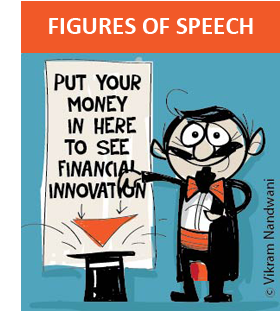
According to the IMF's Financial Access Survey for 2016, India had over 1.2 lakh branches of commercial banks across the country, which is higher than the number in the US, China, Brazil, Russia and South Africa in 2015. However, this translates to over 13 commercial bank branches for every 100,000 adults, which on the flip side, is much lower than in the case of Brazil, Russia, the UK and the US. In this respect, China is no better than India with 8 branches for every 100,000 adults! Despite progress in the other economic spheres at a macro level, India lags behind most major economies in the access to bank accounts. Econocrats and central bankers have long echoed the importance of financial inclusion and yet we lag behind when it comes to access to banking. And here is where financial innovation through technology and other concepts come to play.
Financial innovation has been the buzzword in various economic sectors. News of Indian public sector banks opening up to the idea of this concept is not uncommon. A host of players, including telecom firms, small finance & payment banks and financial technology companies, are leveraging the power of technology to reinvent and offer faster, cheaper and more convenient financial products and services to expand its reach. These will eventually culminate to help entrepreneurs and SMEs. Financial technology, or fintech, is an upcoming realm yet to pick up pace in India. At the same time, many adverse incidents have questioned the use of technology while innovating the BFSI sector. Case in point is the 2016 Bangladesh Bank cyber heist.
Nevertheless, India is well on its way to speed up the process of financial inclusion revolution and indeed has a long way to go. To some, the story of innovation in India is one of contradictions what with the country spending much lower than what China does on R&D, and yet, we have some 1,000 multinationals setting up their research centres here. Innovation is the key here to unlock the potential of a growing economy and for further progress.
In ET this month, we feature the subject of Asset Leasing & Other Financial Innovations.
While financial innovations are important, careful regulation is paramount. Jay in the Thinking Aloud section stresses this importance, citing illustrations stemming from the global financial downturn and the BFSI sector.
Shrirang Tambe, CEO of ORIGA Leasing, shares his thoughts on innovations in the financial markets, in the Podium section. He advocates that financial innovation helps in tending to the needs of entrepreneurs and enterprises.
In the We Recommend section, we walk down memory lane in the making of India's premier Bank - HDFC. Business journalist and author Tamal Bandyopadhyay in his book, A Bank for the Buck, examines how a modern bank with the help of novel ideas, came into existence at a time when the banking & financial sector in India lacked trust.
In Standing Ovation, we feature Gujarat based Charutar Arogya Mandal which serves the under-privileged strata of the community by providing medical help and education at subsidized rates.
In Figures of Speech, Vikram's magician tries his hand at financial innovations!
In this festive season, Team ELS would like to wish our readers a Happy Diwali!
As always, we value your opinion, so do let us know how you liked this issue. To visit our previous issues you can visit the Resources section on the website or simply Click Here. You can also follow us on Facebook, Twitter, LinkedIn & Google+ - where you can join our community to continue the dialogue with us!
|
|

|
|
Financial Wizardry: Who Pays the Price?
|
|
- Jay
|
|
There has always been an aura around the guys who know their numbers! Look at the fan-following for stock market gurus & the leading bulls whose tips are lapped up by hungry followers. There is a whole industry (well, almost) built on tracking Rakesh Jhunjhunwala's stock market moves! And, even inside organizations, the Finance function has always been considered the 'special ones' with an inside track to the C-Suite business decisions, thereby causing some awe & a lot of fear in other lesser organizational mortals.
Nowhere has this been witnessed more than in the Banking & Financial Services Industry (BFSI). BFSI members are the movers & shakers of any country's economy. They receive a lot of airtime in the media & appear knowledgeable about emerging trends & make predictions of how the markets will move in the coming days.
However, in recent times, many adverse incidents in the global economy have damaged reputations & landed a series of crushing blows to the titans of the BFSI sector.
Things began to unravel in 2008 when the bottom fell out of the global finance industry with one after the other firms considered 'too big to fail' displaying unexpected & unforeseen hollowness. When the sophisticated veneer of respectability fell-off, all one could see was a unholy mess of deceit, fraud & greed. The malfeasance, misfeasance & nonfeasance of Banks & other financial firms on both sides of the Atlantic triggered fatal down-turns in all the economies of the world. With hundreds, nay thousands, of innocent victims of the financial tsunamis, what was sad to note was that the largest number of those affected was the lower & middle income classes. Sure, a few billionaires turned millionaires but the larger numbers affected by the Housing market collapse were those who literally lost their houses & investments. And, when the financial tide receded what was left in the wash were a few very rich bankers who hired fancy lawyers to plea bargain, pay fines and escape with short period punishments.
The funny part also is that many spend relatively short time in a penitentiary, get released on grounds of good behavior and write a best-seller on their misdemeanors. Their wages of sin are paid back soon enough and they seem to make a quick return to their favorite haunts & watering holes. Soon enough, it seems, to be able to make money and whitewash their past and gain respectability again. While this seems like an American tale, even in India, this show has been played out often enough, the only difference being that the jail terms are temporary judicial custody periods, given the fact that financial cases never fully get completed (cases in point, the Satyam saga, Kingfisher, Sahara, et al).
However, like a bad dream, and rather like the product recalls in the auto industry, despite claims of being value driven, transgressions continue to mount up. The recent travails of Wells Fargo Bank in the United States and Deutsche Bank in Europe, are only the latest episodes of what seems like long-running soap operas where CEOs guiltily parade in public, mouth mea culpa & claim 'systems failure' for gross ethical breaches and walk away with fines. The bruise to their reputation is usually very temporary but the galling fact is that they saunter away with substantial personal wealth despite having destroyed the collective wealth of many innocent depositors who fell victim to their guiles and misguidance in the name of financial innovations. This venal disease of personal aggrandizement has not even spared the micro-finance sector which also has witnessed dubious transactions fueled by financier's greed couched in the garb of social good.
In the name of financial innovation, much has been attempted over the years. Typically, financial innovations are classified as either Financial system or Institutional innovations; or, as Process Innovation; or, as Product Innovation. While all three are necessary in emerging markets like India, the fact is that regulators are always late in the game. While it is true that excessive and overbearing governmental regulations stifle the growth of financial markets, the absence of controls has led to unbridled exploitation of the gullible through 'get-rich quick' schemes which keep flooding the market.
Be that as it may, the need for financial innovation of all the above three types cannot be stressed enough. And, leveraging the power of technology for delivering financial access to the under-privileged has been the biggest boon to create financial inclusion in the economy. So also other steps like mobile banking, asset restructuring, micro-finance, crowd-funding, angel investing, etc. More of these would be welcome but careful regulation is also necessary to filter the bad elements from ruining or diluting the positive benefits to the customer. It would be wise to heed the words of the former Governor of the Reserve Bank of India, Raghuram Rajan, who mentions in his seminal work, 'Fault Line: How Hidden Fractures Still Threaten the World Economy' (where he studied the triggers to the great economic collapse of 2008), that, 'The problem was not that no one warned about the dangers; it was that those who benefited from an overheated economy - which included a lot of people - had little incentive to listen.'
So, a judicious mix of prudence with innovation is what the doctor would advise any growing economy.
back to top ^
|
|

|
|
Interview with Shrirang Tambe
|
|
Founder and CEO of ORIGA Leasing
|
 Shrirang Tambe has extensively worked in the field of investment banking and private equity. He is the Founder and CEO of ORIGA Leasing one of the first FinTech asset leasing companies for high growth oriented companies with a philosophy of access to finance. ORIGA Leasing is instrumental in providing highly innovative asset leasing solutions for sectors such as healthcare, manufacturing, sanitation, water, energy and services. It is one of the first leasing companies to extensively leverage technology for providing complete Asset Life Cycle Management (ALCM) to its clients.
Earlier, he was also the Founder of Ourea Capital Advisors, a boutique corporate finance advisory company, that provided an entire gamut of growth capital advisory to high growth companies.
His expertise lies in advising and nurturing growth oriented companies across financial and strategic areas. He brings with him over 12 years of experience in the financial services sector and has worked with several companies in the domains of business planning and strategy formulation, financial modelling and budgeting, fund raising, private equity investment and post investment asset management. He has worked with CEOs and management of several companies in building up a robust growth strategy.
Shrirang Tambe is a Chartered Accountant and a CFA Level 1 candidate. He has been a speaker at various conferences in India for prestigious institutions such as ICAI, various chapters of CII and SME Chambers and various international conferences. He has been a visiting faculty to many business schools in Mumbai in the area of corporate finance and valuation.
ET: In recent years, innovations in the financial markets have been the cause of much heart-burn to regulators, investors & customers alike as some believe that market turbulence has been caused by 'fancy innovation'. What are your thoughts on innovations in the financial markets?
ST: Innovation in the financial markets was long overdue. Since the industrial era of India till date, we had only two financial products to fund businesses - working capital loan and term loan in addition to promoter equity and informal channels of financing. In the early 2000, a new class of capital in the form of equity investment came into existence which is today popularly known as venture capital and private equity. Even today, India seriously lacks both, the depth and breadth of fixed income (debt oriented) financial products to fund businesses on a sustainable basis. Conceptually, equity is raised only at a time when a steep jump in business is expected or required. However to grow the business in a sustainable manner and over a period of time, debt capital is the most critical. Thus you will observe that innovations in the financial markets are predominantly in two segments - payments and lending. Payments have revolutionised the way people spend across various platforms. Lending has seen innovation in the form of marketplaces and various platforms are coming up to fund small businesses, merchants, salaried people and the various strata of the society which were left out of the traditional financing system.
ET: Asset leasing plays a significant role in financing corporate needs across the globe. However, this trend has not caught on much in India. What could be the reasons for this?
ST: Asset leasing is a very powerful financing product to build and augment capacities required across segments to enable growth. In the USA, 75% of SMEs are financed through asset leasing which is estimated to be a US$ 1.3 trillion industry. According to us, India is one of the most under penetrated markets when it comes to asset leasing. The key reasons for asset leasing not catching up in India:
| (a) |
Over emphasis by the traditional financing system on their conventional product of Term Loans and making people believe that it is "one size fits all". |
| (b) |
Lack of focus from the regulators to promote the same. |
| (c) |
Quagmire of tax laws with respect to leasing and retrospective amendments to the same hurting the industry. |
Things are beginning to change now and a lot wider acceptance of this innovative financing product is seen. We thus believe that leasing will grow over a period of time.
ET: SMEs play an important role in contributing towards the national economy. Often they are impacted by financing challenges among other bottlenecks. How does financial innovation help in tending to the needs of such enterprises and that of entrepreneurs?
ST: Financial innovation brings about financial inclusion not only at the B2C level but also at B2B level. The newer products introduced by the alternative financing eco-system reaches a large number of SME companies who were earlier completely devoid from financing since they did not tick all the boxes of a traditional financer. For example, ORIGA looks at leasing to companies who are just one year in operations whereas the standard norm in the banking segment is to fund only after three years of operations. The fundamental difference between the newer financing companies leveraging on innovation and technology and the traditional financing system is that the newer players are more focused on the future while the traditional companies put excessive emphasis on the past.
ET: Recently Micro-finance firms have been the target of acquisitions by larger predatory Banking players. In your view, does this mean that innovators in the financial sectors can only grow by joining hands with larger financial firms?
ST: Mergers and acquisitions in financial services happen for various reasons thus innovation is not the sole driver for it. Innovators can definitely gain by collaborating with larger firms when the products and services are complimentary to a large extent. However it is not necessary that success will come only from collaborations. If the product offering is strong and has a niche positioning among its consumers, innovators today have the opportunity to expand by themselves.
ET: Being a first of its kind, how does your company, ORIGA Leasing, stand out from your competitors? Can you please elucidate some of the innovative financial solutions offered by your company?
ST: ORIGA Leasing is India's first FinTech to provide the entire Asset Life Cycle Management (ALCM) to its high growth SME clients. Thus financing is a part of ALCM. ORIGA assists an SME client right from procurement of the asset to its end of the tenure recycling which no other pure play equipment financing company does. ORIGA is also the first to deploy a strong technology backbone including mobile based solutions to this entire business process and the lessee will be able to carry out all the necessary activities with respect to its equipment with a click of a button on his mobile. ORIGA is a perfect blend of balance sheet financing and technology driven business processes which makes the model highly scalable. Looking at a first of its kind technology in the B2B financing space, 500 Startups, a highly reputed global venture capital seed fund and start-up accelerator has invested in ORIGA and has listed it among the top 15 investments it has in India.
back to top ^
|
|

|
|
A Bank for the Buck
|
|
- Tamal Bandyopadhyay
|
 Business Journalist, Tamal Bandyopadhyay in his book, A Bank for the Buck, takes us on a journey on the making of today's top banking name - HDFC Bank. The transformation from the Housing Development Finance Corporation Ltd to HDFC Bank of today has not been an easy task. The author, through a thorough research and close watch of the Indian financial sector for over fifteen years, has highlighted this in his first book. Business Journalist, Tamal Bandyopadhyay in his book, A Bank for the Buck, takes us on a journey on the making of today's top banking name - HDFC Bank. The transformation from the Housing Development Finance Corporation Ltd to HDFC Bank of today has not been an easy task. The author, through a thorough research and close watch of the Indian financial sector for over fifteen years, has highlighted this in his first book.
Bandyopadhyay has maintained an informal style of narration and the entire story of the making of HDFC Bank does not run chronologically but thematically. The first section of the book illustrates how the bank was conceptualized, the making of the core group of people (whom he humorously tags as the Dirty Dozen) and how the first recruits of the bank not only supervised the building of its first brick and mortar headquarters but were also trained under a tree! Bandyopadhyay delves into the decision making process of each of the leadership team who made a choice to leave their high paying jobs for the opportunity of building a bank in the newly liberalized India. He examines how the first set of banks started operations in the country after the RBI opened doors to private sector players; few of these banks survived the competition while others just fizzled out.
The heart of the book lies in the second section which elucidates the bank's business philosophy. The author makes some interesting comparisons between various banks and HDFC Bank stating that the latter "is staid and waits for opportunities but emerges a winner at the end of the day." Among many other important concepts, the bank was one of the first to leverage technology to start mobile banking coupled with other philosophies such as product innovation and risk management.
Inspite of the various strides that HDFC Bank as a bank achieved, the book examines how it came under the RBI's scanner and was penalized on two occasions - the derivatives and IPO scams. However, these events were not only turning points in the history of HDFC Bank but the bank took steps to avoid getting into such a mess in the future and ensured that 'safety valves' were in place. An entire chapter is also dedicated to the 'Common Sense Banker' - Aditya Puri, the longest serving Chief Executive Officer of any bank in India.
A sneak peek into HDFC Bank's history and its culture, the book makes for a compelling read even for non-banking and non-finance professionals who often shy away from otherwise heavily loaded finance topics. However, note that since Bandyopadhyay's narrative is informal and the fact that the author peppers the narrative with too many characters and trivia, like an early ban on using paper cups as a cost saving measure for all times (which gives us a view of the Indian entrepreneur's mind-set), can make the reader go a little off course.
Aside from the tedious amounts of detail about every one of the "Dirty Dozen", the key lessons from the HDFC Bank story is that the freedom for professional managers, non-interference by the Board and the Promoter and passion for success are more important than ownership. The book illustrates this formula - something new private & existing banks and corporates as such, can imbibe.
back to top ^
|
|

|
|
Charutar Arogya Mandal, Gujarat
|
 Charutar Arogya Mandal (CAM) is a project that was founded in 1972 by Dr H M Patel, a former Union Finance and Home Minister with the goal of providing comprehensive and personalized healthcare that was affordable to everyone. Today, the Trust manages a full-fledged medical college, hospital and other medical centres, all while staying true to the original goal of maintaining quality and affordable healthcare.
Some of the facilities under CAM include:
- Patient Care: The H M Patel Centre for Medical Care and Education and the Shree Krishna Hospital at Karamsad, through many of its special programmes attempts to provide its services to economically challenged persons in a subsidized manner.
- Medical Education: The Educational Institutions at CAM aim to go beyond conventional education to design programmes that prepare students to become competent medical professionals who are more skill-based and innovative. CAM hopes to extend their educational system to other vocations like physiotherapy, nursing and medical technology.
- Community Extension: CAM aspires to be a part of the public health initiatives by managing extension health centres. Under its ambit, they currently run five such centres and provide indoor care. They also run various Krupa Schemes (in-house healthcare schemes) that provide indoor treatment worth Rs 5,000 per annum for a sum of Rs 99.
CAM stands firm in its vision: to be a shining example of what the profession of medicine is supposed to be - noble, deeply rooted in providing solace to the suffering and continuously upgrading itself to serve the humanity.
For more information about CAM, please visit http://www.charutarhealth.org/
For their noble cause, CAM deserves a Standing Ovation!!
back to top ^
|
|

|

|
| In-house Naturalist Rupesh Balsara captures a captivating shot of the waterfall at Thamini Ghat near the Kundalika River during the monsoons. Located 140 kms from Mumbai and very close to Pune, the Ghat is a sanctuary for adventure lovers and a hotspot for biodiversity. |
|
|
|
Empowered Learning Systems
Pvt. Ltd.
http://www.empoweredindia.com
101, Lords Manor, 49, Sahaney Sujan Park,
Lullanagar, Pune – 411040,
Maharashtra, India


|
 The ELS Lotus logo is trademark of Empowered Learning Systems Pvt. Ltd. The ELS Lotus logo is trademark of Empowered Learning Systems Pvt. Ltd.
©2016 Copyright Empowered Learning Systems Pvt. Ltd. (ELS). For private
circulation to clients and well-wishers of ELS. While ELS endeavors to ensure
accuracy of information, we do not accept any responsibility for any loss or
damage to any person resulting from it.
|
|
|
|
| |