|
|
|
|
| |
Dear Reader,
Are leaders born or made? Regardless of what the answer is, one thing is certain - leadership is an evolving function and leaders have to evolve with the changing business environment.
The leadership journey is not a linear one where today's business leaders have to tide over complex business challenges. For many organizations, surviving in today's environment depends on making a fundamental transformation to become more agile. To build and lead an agile organization, it is imperative that leaders develop new mind-sets and capabilities to transform themselves and the organization. Developing agile leaders is the way forward.
ET this month delves into the theme - 'Growing Effective Global Organizational Leaders. In the Thinking Aloud section, Jay highlights the changes that the leadership function has gone through and the importance of leadership communication today. Mariano Tufro, Founder & Director- Leadership Minds, on the Podium discusses the skills required to build agile and mindful leaders of tomorrow. We review, Melinda Gates' The Moment of Lift and her take on women empowerment in the We Recommend section. We take a little break from the Voices segment for the next few months but will surely come back with interesting topics to ponder over.
In Figures of Speech, Vikram's toon takes up the Leadership challenge!
As always, we value your opinion, so do let us know how you liked this issue. To read our previous issues, do visit the Resources section on the website or simply Click Here. You can also follow us on Facebook, Twitter & LinkedIn - where you can join our community to continue the dialogue with us!
|
|

|
|
Boris Johnson has taken office as the new Prime Minister of the United Kingdom and in his very first speech in front of No.10 Downing Street, the legendary official residence of the Premier, he emphasised that 'the Buck stops here'.
In echoing Truman, he was reiterating an important element of a Leader's role - ultimate accountability. In the final analysis, Accountability is all about being answerable for your actions, an acceptance that you are liable not just for the actions & processes but for delivering on the promise, the final results. A much valued virtue, regrettably too often this remains a hollow promise. While Johnson will be severely tested in the coming months to deliver on his commitment of Brexit (with or without a deal with the European Union), few can doubt that one quality he has in plenty is his ability to communicate with his band of followers. Not for nothing did he canter easily through to the pole position in the Conservative Party's leadership stakes, and thereby land the big prize - the Prime Minister's chair. Few doubt that he deserves all the negative adjectives used by his detractors to describe him (can anything be worse than being called UK's Trump?) but none can deny that he can spin a vicious web of words around his targets.
By now it is amply clear that central to a leader's performance is his ability to galvanize others towards the desired outcome. And, truly, if there is one instrument that enables this performance, it is the ability to communicate. The impact of a powerful speech before a live audience is indeed amazing. Delivered with panache, stirring emotions in every heart, with just the right dose of humour - these delightful ingredients can be robust arrows in the quiver of an ace communicator.
Things were not the same always. In days past, the law of primogeniture ensured that vassals accepted the sovereign's right to rule without much argument. The need to reach out to your team with inspirational words may not have been vital in that era - when the tendency to accept your sovereign as an omnipotent leader was widespread. Any challenger or naysayer would be labelled a rebel and would swiftly meet with the full force of the state more often than not. Hence, even a non-communicator could safely rule on as the office and the royal seal spoke louder than the personal voice of the ruler.
Leadership in the twenty-first century demands more from the leader than ever before. Never has the leader been in greater scrutiny than today, be it in political office or in a business organization. The advent of the internet and the rise of social media has not just armed the leader with channels never before available to any ruler in history but equally has also made him vulnerable like never before. Many of the heroes from history who led pretty colourful lives in their times would be publicly roasted today under the glare of the media's blazing searchlights. Those leaders who have failed to understand this have paid a price. Take for instance, BP's former CEO, Lord Browne, whose career came crashing down due to perjury triggered by media spotlight on his personal life. That was in 2007 and CEOs then had yet to learn the hard lesson that once you reach the top you are fair game to the media who see no distinction between the public and private persona of a Business leader. While the business press now may not quite behave like the paparazzi at the heels of a celebrity but in a world where CEOs are Page 3 personalities, they cannot complain when some dig out dirt from their not so shiny past. Lines are blurring as many CEOs are brazenly using well-heeled public relations agencies to stay constantly in the social limelight arguing that this benefits their business enterprise too. Taken to the extreme, globally we now see many more extremely rich businessmen take political office, emboldened by the success of American politicians. The case of the new Brazilian president, Jair Bolsonaro, is but the latest.
Lest we forget, good communication is also about active listening. However, this is the neglected dimension. When was the last time you heard praise for a leader being described as a good listener? But naturally, this would require the leader to be largely quiet and pay close attention to someone else. Such reticent and taciturn leaders would be under severe scrutiny nowadays. It is not just the narcissistic leader who loves to hear his voice. At a time when the leader is required to be facile in addressing townhalls, shareholders, analysts and the enquiries of the press, it is difficult to be just seen and not heard. No amount of middle men sending tweets on your behalf will do, as telegenic and cheerful sound bites are an important element of motivating not just employees but keeping the Street positively engaged with you. Additionally, picking tips from a modern politician's playbook could be useful as they are past masters in keeping constituents happy!
Let me clarify. It is not that a Leader's role is limited to looking good and making snappy comments. Quite to the contrary; leadership is a multi-dimensional role, difficult to encapsulate into easy terms. Nevertheless in an era where the medium is the message, and average attention levels are crashing rapidly, it would be foolish to assume that style is not more important than substance. While style with substance is the real deal, at a time when judgements are made in a blink, perhaps it would be fatal for a leader to ignore their style quotient.
back to top ^
|
|

|
|
 Mariano is a global specialist in Senior Leadership Development, Talent Management, Executive Coaching, High Performing Leadership Teams, and Agile Leadership. He has more than 22 years of experience working for or consulting blue-chip companies. His passion is growing agile, mindful, connected global leaders.
Mariano has worked with senior leadership and HR teams across the world to define and implement learning strategies that align talent with organizational goals. He has extensive experience creating talent development programmes for high potentials, facilitating workshops, coaching senior leaders, and developing high performing teams. Mariano has worked across the USA, South America, Europe, Middle East, Africa and Asia Pacific.
As a guest lecturer on Executive Coaching at Birkbeck College, University of London, and through various speaking engagements, Mariano disseminates the application of neuroscience and technology to leading self and others. He's an experienced public speaker, having delivered keynotes to Senior Leadership audiences around the world.
Mariano has a Masters in Organizational Behaviour, a Postgraduate Diploma in Computer Science, and a Bachelor in Business. He is also a certified Executive Coach (Academy of Executive Coaching), Level B in Occupational Testing (British Psychological Society) and holds certifications for various psychometric instruments including EQi, MBTI and Profilor. He combines this solid academic background with accelerated learning principles, social learning, mindfulness and the performing arts. As a result, his solutions, workshops, coaching sessions, team development interventions and keynote speeches are rigorous, engaging, fun and immediately applicable.
ET: How would you define today's business leaders?
MT: I think today's business leaders are faced with challenges that require a higher level of thinking. In the words of Robert Keagan, they are "in over their heads", and need to develop vertically as well as horizontally.
ET: What are the essential skills required to develop agile & mindful leaders in light of the future of work?
MT: Horizontal development encompasses the usual skills that leaders learn in leadership development workshops: emotional intelligence, interpersonal skills, strategic planning, facilitating team interactions, coaching direct reports, building relationships with a variety of stakeholders, create collaborative cultures and leading change, amongst others.
Mindfulness underpins many of these skills, as the ability to be fully present in the moment helps leaders be more aware of their own thoughts and emotions, build empathy with others, and avoid distractions. Agility refers to the ability of flexing our plans as circumstances change. An agile approach to change leadership, for example, sees change as an iterative process, rather than a sequential one.
Vertical leadership development, on the other hand, focuses on how leaders think, not what they think about. It uses adult development theories to help leaders deal more effectively with volatility, uncertainty, complexity and ambiguity. Examples of developing vertically include the ability to hold two opposing ideas simultaneously (polarities), thinking systemically, metacognition (thinking about thinking), contextualising and thinking in terms of interdependence.
ET: Given your global mission of building leaders, are there any inherent differences that you have seen between leadership styles, values, behaviours, etc. across regions and countries?
MT: Each part of the world has its own set of socially constructed norms and values. Everybody in that group accepts these norms and values as "normal", and this reflects in how leaders behave in those environments. The skills required to lead people don't change, as human beings are fairly homogeneous psychologically speaking. It's how we use those skills that needs to be adapted to different contexts. For example, assertiveness is a good skill to develop if one struggles with expressing ideas in a concise, compelling way. Being assertive, however, looks very different in a direct culture like Germany, versus an indirect culture like the United Kingdom. These are generalisations, of course, as each individual is unique. What researchers on culture have observed, though, is that certain characteristics tend to differentiate cultures reliably when using techniques like factor analysis. Culture influences behaviour but does not determine behaviour. The environment in which we grow up influences our values and behaviours, but we must always remember that human beings are complex and can't be reduced to a cultural or racial stereotype.
ET: The VUCA environment is bound to pose challenges to leaders. What is your advice to overcome these challenges?
MT: The main thing that leaders need to remember is that we can't try to find simple solutions to complex problems. Simple problems are those in which we know the solution, which is normally well defined. Complicated problems require expertise or know-how to solve. Complex problems are unprecedented, and require an agile, iterative, experimental approach. If we try to apply simple solutions, or best practices, to complex problems, we tend to find sub-par solutions, or fail to solve the problem altogether. When facing a complex problem, an agile mindset is a better way to go.
Another thing I would recommend is developing vertically as well as horizontally. We can't solve complex problems if we don't elevate the way we think about them. Leaders in a VUCA world are "in over their heads" more and more often and need to find new ways of thinking.
Finally, I recommend leaders to expose themselves to a diverse set of stimuli. Network with different people, rather than always hanging out with the same crowd. Travel extensively, to expose yourself to different cultures and ways of looking at the world. Hire people that don't think like you, so you encourage innovative solutions in your team. Try activities that you've never considered before, to expand the way you look at the world.
ET: Can you please tell us about your company, Leadership Minds and what makes it different?
MT: Leadership Minds grows leaders who people choose to follow.
Our workshops don't use artificial case studies, scenarios or games that have nothing to do with the actual day-to-day realities that leaders face. We use a variety of activities to help leaders explore their real problems, conversations and challenges. They will work and learn, making the best use of their time with us.
Our executive coaching is based on a combination of support and challenge. We encourage leaders to make progress in-between sessions, rather than hoping for the best.
Finally, our team development and leadership development consulting are pragmatic, rigorous and agile.
back to top ^
|
|

|
|
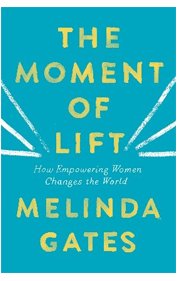
"When we lift others up, they lift us up too"
- Melinda Gates
The book is an eye opener on many levels. As Melinda Gates traverses through her personal life she exposes us to women's issues that need urgent and continuous effort - child marriage, empowering mothers, family planning, girl education, inequality of payment, gender bias and women in the workplace. All these issues are interwoven and for the ‘lift' to happen, there must be progress on all these fronts parallelly. To quote Melinda Gates as to why she wrote this book - "That is why I had to write this book - to share the stories of people who have given focus and urgency to my life. I want all of us to see ways we can lift women up where we live".
This has been a personal journey for Melinda Gates, and she has taken the life lessons that she has grown up with through her role as a daughter, student, wife and mother and expanded it on a wider canvass. She realised that to advocate the cause she had to become a part of it. Starting in 2012, to cosponsor a family planning summit in London, she was pulled to do more to uplift the cause of women around the globe - covering Senegal, Kenya, India, Indonesia, Rwanda, Philippines with the firm belief that the when we empower women, we empower humanity. One can only marvel at the conviction with which Melinda Gates tackles issues which are a far cry from the environment that she lives in.
The soul of the book is Melinda's belief that only the empowerment and uplift of women that will bring about a change in society. This must start from the time a girl child is born, her access to education, empowerment in the workplace, decision of whether and when and whom to marry, role as a mother and voice in family planning. She emphasises that an environment must be created where women are not afraid to question, freely express their thoughts and stand firmly for their beliefs. Only then would they have been ‘lifted up'. Backed by compelling data, stories are told of remarkable women who overcame many excruciating obstacles and others who are shaping lives by working to uplift women and children and willing to help by sharing and connecting.
This inspirational book touches each one of us and highlights issues and shows how we can in our own circle of influence help improve the lives of women. She inspires us to engage with society and help support groups working for the empowerment of women. Each one of us can do our bit in our own small way. On a larger scale this translates into women being confident of making more informed choices and decisions which in turn converts to better communities as women tend to look at benefits for the families and communities thus lifting everyone up. Melinda Gates writes with the firm belief that when we achieve gender equality, we lift not only women but humanity.
A champion advocate for women and children, Melinda Gates needs no introduction as a philanthropist and businesswoman. Co-chairing the Bill & Melinda Gates Foundation, the Gates couple have rewritten the rules of philanthropy. Melinda is also the founder of Pivotal Ventures, an investment and incubation company, which is focused on social progress of women and families in the US.
back to top ^
|
|
| |
|
THROUGH THE LENS
|

|
In-house bird photographer, Rupesh Balsara spots the brown-headed gull, a species found in the Indian subcontinent, southeast Asia, China, Tajikistan and Kyrgyzstan. Highly migratory in nature, the brown-headed gull's call is a loud, raucous "keear" or "geek" sound. These gulls feed on mostly fish, shrimps and insects specially at tropical and sub-tropical wet grasslands.
|
|
|
|
Empowered Learning Systems
Pvt. Ltd.
www.empoweredindia.com
101, Lords Manor, 49, Sahaney Sujan Park,
Lullanagar, Pune – 411040,
Maharashtra, India


|
 The ELS Lotus logo is trademark of Empowered Learning Systems Pvt. Ltd. The ELS Lotus logo is trademark of Empowered Learning Systems Pvt. Ltd.
©2019 Copyright Empowered Learning Systems Pvt. Ltd. (ELS). For private
circulation to clients and well-wishers of ELS. While ELS endeavors to ensure
accuracy of information, we do not accept any responsibility for any loss or
damage to any person resulting from it.
|
|
|
|
| |


