|
 Roshan L. Joseph has over 35 years of marketing and sales experience. He is a well-respected professional in both, the advertising world as also in the marketing field.
He has also authored a book on sales management titled 'Salespeople Don't Lie' published by Sage publications.
He has been the Executive Director on the Board of Eveready Industries India Ltd., with the accountability for marketing and sales. While in Eveready, he was instrumental in bringing Eveready out of the cold with the path-breaking advertising campaign "Give me Red". This was a repositioning of Eveready as a brand that could connect with the youth. It won 11 advertising and marketing awards and continues to date, the way Eveready advertises. He has since been the MD of a Swiss MNC in the Kitchen Solutions business and today is specialized as a consultant in marketing and sales.
In 2004, Roshan, as Managing Director of Franke, a Swiss MNC, had the challenge of establishing the brand, though no 1 world-wide, into the Indian Kitchen scene. Today Franke is well established as a premium brand of kitchen sinks. Here too, he established a unique positioning and developed a distribution to develop the brand.
He is a Past President of the Advertising Club of Calcutta, having made significant contributions to the growth of the industry in the eastern region. He was instrumental in creating the first industry/academia effort to bring in a professional advertising diploma in Advertising in cooperation with St. Xavier's College, Calcutta. Roshan also taught Principles of Marketing to the first-year students in the BBA program of St Xavier's (then a part of the Calcutta University, now an autonomous university).
In 2007, he started a marketing and sales development company of his own with collaborating with Carew International, Cincinnati, USA. He has worked with diverse clients across the Middle East and India.
ET: Why is the sales function considered a science and an art?
RJ: Sales, or the process of making a sale, has evolved since its inception, as a personality-based art form. Great salespeople are eulogised and honoured, yet no one really cared to figure out the science of selling. It is much better to have some mystique over the ability to sell, rather than make it an idiot-proof system, that everyone can copy. Magicians never tell, so that magic never dies.
Over 45 years ago, Jack Carew, a phenomenal salesperson, discovered that every time he moved out of a sales territory, the results would crumble. This got him curious. He commissioned a study by a college Professor to assess what it was that he did while making a sale and how do other salespeople do the same task.
To his surprise he discovered that everybody did whatever that delivered an order. There was no common approach. No system, no discipline. He wondered why the profession did not get the respectability that was commanded by Doctors, Architects and Engineers. He set out to make a difference to this and committed his life to Professional Selling. Carew International USA, has over the better part of the last 50 years, worked to make sales a science. Their flagship program is available over most of Asia, Middle East and India, of course called the 'Dimensions of Professional Selling'.
Sales is a science of how to serve the customer better. Anyone can do an acceptable job and get the required sales. Once that is mastered, there is no ban on being an artist while selling.
ET: How has the sales function evolved? What role has technology played in enhancing this function?
RJ: Sales evolved based on personalities. In my book, 'Salespeople Don't Lie', published by Sage, this evolution has been written of. In the early days, the salesperson was the repository of all product knowledge and there was a very ambiguous line between fact and fiction. There was no way to check facts. Relationship building was the key (it still is important today). The sales image got sullied with the hard-selling automotive salespeople. At the worst of Nixon's presidency, there were cartoons showing Nixon with the caption 'Would you buy a used car from this man?'
As information became freely available with technology, the consumer became more knowledgeable. This made making wild promises and statements more difficult. Today, the consumer has many sources of information and checks user reviews before buying. This development is a positive one as the final test of a profitable sale is also when the consumer is convinced that the decision taken was a smart one.
Technology has also come to supervise the working of the salesperson. Today it is easy to track where your emissary is working. Management information is readily available to the salesperson to make a judicious sale. The unique contribution a salesperson still can make is to build relationships of trust. A software is a cold substitute to the warm handshake from a professional salesperson.
ET: In meeting sales targets, customer needs can sometimes be overlooked. What are your thoughts to avoid this?
RJ: This quite simply is sales malpractice.
Yes, across the world there is focus on the way a sale is made. There are several instances that ignoring the customer's needs, resulted in losses. Companies have a way of quietly writing off the 'mis-capades' of their sales staff but the bad debts are being questioned. Some companies are taking erring salespeople to court too.
As the premise of a good doctor is the wellness of the patient, so also is the need satisfaction of the customer the prime objective of the sales personnel. When the doctor works against the interest of the patient it is medical malpractice. Similarly, when salespeople sell against the interest of their customer, it is quite simply, sales malpractice.
ET: In your experience, what is your advice to our readers who would like to master the art of selling?
RJ: There are many reasons people choose to be in sales. Good money is not a reason to ignore. However, you need to ask yourself why would you choose a career that is demanding physically, requires travel, uncertain food, both in quality and timely eating, questionable hotels with assured lack of hygiene and be shouted at by bosses when not meeting their targets. You must have a good 'why?'
You must enjoy people. Meeting them, understanding why they should buy from you and overall be determined to serve them and guide them to making smart buying decisions. You must believe that your efforts can shape your customer's destiny. Believe that you can make a difference.
And yes, you will make money as you succeed. A successful salesperson can rise to any management level and be a captain of the industry.
ET: Can you please tell us about your company, B-More Consulting?
RJ: B-More Consulting has its genesis in the frustration of finding sales training that was more noise than substance. In 2007, I scoured the US to find a sensible sales training program that could lift our salespeople to international standards. My experience with home-grown sales training consultants was far from satisfactory.
Carew International, from Cincinnati, Ohio made the best sense to me. Positional selling, as Carew International preached, became the sales training message across India into the Middle East and up to Malaysia. We have also collaborated with Louis Allen International, based out of Bangalore, for content on Management Systems covering all areas of Planning, Organizing, Leading and Controlling...the work all managers must do every day.
All facilitators are trained by the rigorous Carew Accreditation system. Each Dimensions of Professional Selling (DPS) program is done true to the Carew modules with local flavour and case studies. The Carew delivery ensures an engaged participant who experiences the learning with fun and a dynamic competitive spirit. The takeaway after the DPS three-day program is a more powerful motivating force than any motivational speaker can achieve. Sales teams leave with skills they can use for life.
back to top ^
|








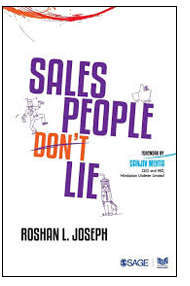 Roshan Joseph has written a very readable book on sales that touches all the important points that salespersons and sales managers need to be aware of.



 The ELS Lotus logo is trademark of Empowered Learning Systems