|
|
|
|
| |
Dear Reader,
The Indian tourism and hospitality industry have emerged as the key sector driving growth of the Indian economy. To cater to the increasing inflow of tourists, the sector needs world class hotels, resorts and supporting infrastructure. Design thinking and innovation are buzzwords in building unique resorts in the hospitality space offering detail-oriented services which are aimed at creating and making memories last for tourists and guests.
ET this month looks at the 'The Design Challenge of Creating World Class Resorts: An Indian Perspective.'
On the Podium, we speak to Della Group's Founder - Jimmy Mistry, who explains the concept of leisure and hospitality designs in India and the challenges of creating world-class resorts.
In the Thinking Aloud segment, Jay's thoughts on India's evolving travel & hospitality sector is guaranteed to put you on vacation mode. In the We Recommend section, we review Shoe Dog by Phil Knight, a memoir of the author's journey in establishing brand Nike.
In Figures of Speech, Vikram's toon is on vacation mode!
As always, we value your opinion, so do let us know how you liked this issue. To read our previous issues, do visit the Resources section on the website or simply Click Here. You can also follow us on Facebook, Twitter & LinkedIn - where you can join our community to continue the dialogue with us!
|
|

|
|
The incredible India campaign has largely been considered a major success, not just because it increased the mind space amongst global tourists but also because international tourist arrivals into the country have increased over the last few years.
This is despite the many challenges that tourists face in India in any case. Interestingly, what is often unnoticed is the rise in domestic tourism. A study last year indicated that in 2018 there were 1.82 billion domestic tourists who traversed across the country. The number just 2 decades ago was 220 million. Surely, the phrase 'discovery of India' has taken a whole new meaning! The message is loud & clear, whether it is religious tourism, adventure tourism or just plain 'sight-seeing', Indians today are moving in hordes across the country (and not just across the world).
The GDP benefit of such voluntary travel is immense, as some economists have noted, echoing the call by Prime Minister Modi last year asking citizens to visit 15 destinations by 2022 to give a fillip to the tourism sector. The current average number of trips taken is 1.8, they noted, and even if we double this number, it would mean a significant boost to the domestic tourism sector.
While there are many moving parts that go into the tourism jigsaw, a crucial piece is the Hotel sector. Typically, the two parameters that are critical to the Hotel sector is the Average Room Rate (ARR) and the Occupancy Rate (OR) as they indicate the profitability of the sector. At the beginning of 2019 market experts had predicted a growth of 10-12% CAGR till 2022-23 expecting an overall increase in both OR & ARR. While latest figures are still awaited, the sector saw good growth in the first quarter of last year and then faced a tough period thereafter given the anxiety on the economic front all-round. While the sector is not immune to the general economic mood, the stress that the airline sector faced last year (growth of only 3.74% compared to 18.6% in the previous year) gets reflected on Hotel occupancy too.
However, what is evident so far is the major increase of the footprint of global Hoteliers in India. Marriott alone has 120 hotels in its portfolio in India and its appetite remains undiminished, intending to open about 20 more by December 2020. Other major overseas brands too are jostling for attention in the marketplace, while homegrown Oyo has emerged as the world's third largest & fastest-growing hospitality chain (with its product line of leased and franchised hotels, homes and living spaces). Clearly, the best is yet to come for the Indian tourist.
While opportunities abound, so do challenges. The sector is no stranger to the issues of sustainably & customer expectations which bedevil all businesses, but also has other concerns peculiar to itself. Let's take the people challenges to start with. It is widely accepted that service orientation is the life-breath of this business. While 'Atithi Devo Bhava' is the traditional approach of India, the reality is that making this into the bedrock of operations & the basic culture at all times requires intense training at all levels to meet the standards & expectations of today's customers. Added to this is the reality of employee attrition which have always been higher in this sector given the challenging & labour-intensive nature of jobs & long working hours. Leadership in the service sector has to marry this with modern technological investments as service expectation is a changing goal post. This is also one sector that is capex hungry as investments to maintain physical assets is ever expanding. All this while fighting price battles in the market place as competition is often global with every country seeking tourist dollars. The industry has perpetually sought support from government and allied agencies (municipal authorities, police, etc.) – often not forthcoming readily - as multiple factors (national, local and international) come into play making this a vulnerable sector in many ways.
Despite these challenges it is wonderful to note that a new breed of hoteliers have emerged, drawing inspiration from the big three of yore: the Taj, the Oberoi & the Leela Groups. So, we find today that the range of hotels has grown, - Ecotels, Boutique Hotels, Heritage Hotels, Airport Hotels, City Hotels, Resorts, Forest Hotels, Motels, Timeshare Hotels, Service Apartments, etc. All this points to a robust demand for a variety of services from a growing consumer class that has now got wheels under their feet, eager to go forth & explore like never before.
Strategies of different owners too have modified accordingly to account for both seasonality & cyclicality, to name two characteristics that impact the sector, and some have chosen to be niche operators while others have created pan-Indian networks. The rise of the MICE (Meetings, Incentives, Conference/Conventions & Exhibitions/Events) market is an indicator that leisure, religious & business travel are no longer the only reasons for hotel bookings. The serious players in this segment have creatively offered new product and service additions to ensure that corporates come back to them annually. While Goa is India's poor cousin to Las Vegas & Macau, the growing appetite for adventure & team building has also led to the emergence of some new resorts. So also the desire for destination weddings. Many venues are now positioned for this purpose and so long as the craze for the big fat Indian wedding continues, these hotels too will prosper.
The inevitable conclusion from all the above is that changing social expectations, rise in disposable income, availability of easier travel options, etc., is fuelling a new wanderlust in our country, and this is unlikely to peter out anytime soon. Intrepid businessmen who are willing to accept the associated challenges can be the new torch bearers of the industry. Therein lies the opportunity.
back to top ^
|
|

|
|
 Jimmy Mistry is a Designer, Hotelier, Entrepreneur, Adventurer & Developer. He founded Della Group in 1991 with a core belief that anything he designs or creates should be unique, inspirational, path-breaking and should improve the lives of as many people as possible.
Under the Della Group umbrella, he has launched 5 business verticals: Della Adventure, Della Resorts, DATA, Della Villas & Della by Jimmy Mistry. Having learnt the Design Thinking methodology from the stalwarts of the design industry and implementing the best practices, he now wishes to foray into a unique business vertical of DELLA TALKS.
ET: In your view, what is the current landscape of the leisure and hospitality designs in India?
JM: The Indian consumer has become discerning in the past decade. Leisure and Hospitality have evolved in terms of sophistication and global bench-marking. Consumer expectations are beyond excellence in services, which is now become a basic expectation. Ambience, design and unique spaces have started to make a difference in a way bigger than ever before in this domain.
Experiential tourism is trending today and design is at the centre in most experiential tourism initiatives.
ET: It is said that Design has to be a differentiator. How does Design Thinking enable the creation of this differentiation?
JM: I am a Designer, Hotelier, Entrepreneur, Adventurer & Developer. I founded Della Group in 1991 with a core belief that anything we design or create should be unique, inspirational, path-breaking and should improve the lives of as many people as possible. For me, design thinking is at the centre of whatever we do across all our initiatives and businesses. My belief in design being a differentiator has led to pioneering concepts which in turn has brought about a disruption in each of our Della Group verticals.
ET: What are the current challenges of creating world-class resorts in India?
JM: In India, the awareness and demand for world class resorts has seen a positive upswing. However, the biggest challenge in the current scenario is the economic recession and slowdown in the Travel, Hospitality and Leisure industry in India. The other barrier are the plethora of windows of clearances needed to start a project and the long period of time needed to process permissions. Shortage of skilled employees, high attrition are other impediments in creating luxury resorts in India.
ET: Can you tell us about your company, Della Group and how it has re-defined the leisure and hospitality space in India?
JM: We pioneered experiential hospitality in India - Lonavala by creating India's largest extreme adventure park and now Military Tourism through Della D.A.T.A.
Della Group has been a key driving force in the development of Lonavala by positively disrupting its perception from a mundane hill station to a classy tourism destination of choice.The group also pioneered 'Gen next hospitality' with 6 luxury experiential resorts.
Our strategy is to challenge the status quo of conventional hospitality by inspiring a lifetime of rare experiences. Della Group is a thought leader in the domain of Hospitality as we offer uber personalised service while maintaining the highest standards of service delivery. We are the only hospitality group in India which offers select hospitality services 24 hours a day, every day.
ET: With more than two decades of experience, what is your advice to readers who like you would like to set out on an entrepreneurial journey?
JM: The belief in your business and its clutter breaking offerings and the passion to make it happen transcends any barriers or obstacles that come in the way. Many stakeholders in my case found most of my business ideas absurd but today these very ideas are business successes giving Della Group a first mover advantage.
In other words, create a unique idea with customer empathy and work around it with all your passion. It will all work out!
back to top ^
|
|

|
|
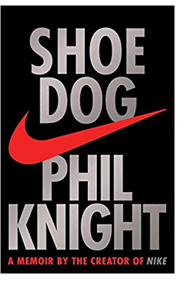
The famous swoosh icon and the tagline - Just do it - is testimony to the efforts that the Founder (now Chairman), Philip (Phil) Knight, stood by in establishing sports apparel brand, Nike.
Nike was built from scratch out of loaned capital from his father. With a simple plan in place of importing high-quality, low-cost athletic shoes from Japan, Knight was on his way in building a company whose annual revenue stood at US$ 36.4 billion (2018).
The author was cash strapped with no bank savings; he would plough back the profits into the company to order more shoes from Japan. Even as sales of his shoes took off, his business was constantly out of steam. His Japanese shoe suppliers were also eyeing other potential US partners, despite Knight's improved shoe designs and marketing strategies. Due credit is also given to Jeff Johnson, his first full-time employee, hired in 1965, whose selling strategies were similar to Knight's. Eventually, Knight broke away and started Nike as a brand of its own. The author deliberately omits any mention of Nike's ad campaign. With the help of Wieden+Kennedy, Nike's advertising changed how the world viewed the world of sports. Nike sparked a revolution in personal fitness, endorsing many athletes, including Bryant, among others. Phil Knight is a graduate of the University of Oregon and Stanford Graduate School of Business. He ran track under coach Bill Bowerman at the University of Oregon, with whom he co-founded Nike. Knight owes much of his inspiration and success to coach Bowerman - a World War II veteran, preparing the youth to face the trials of life. The memoir is peppered with some humour and insights to the world of entrepreneurship, and the challenges that come along the way.
Bill Gates named Shoe Dog as one of his five favourite books of 2016 and called it "an amazing tale, a refreshingly honest reminder of what the path to business success really looks like. It's a messy, perilous, and chaotic journey, riddled with mistakes, endless struggles, and sacrifice. Phil Knight opens up in ways few CEOs are willing to do."
In 1980, the company went public and gained in value. Towards the end of the book, Knight reflects on his own life and admits that he was hard on himself while building his empire, including his self-doubt surrounding his preferred and ultimately, rejected choice for the company's name: Dimension Six. Phil Knight is the 16th richest man in the world (Forbes 400 2019 ranking), and one of the biggest philanthropists in America. The read gives no real business advice to entrepreneurs, but is an honest account of the toil that goes behind creating a brand. Advising the next generation of entrepreneurs...if you do feel overwhelmed, just keep going and just do it!
back to top ^
|
|
| |
|
THROUGH THE LENS
|

|
Our in-house naturalist, Rupesh Balsara, spots Brahminy Mynas. These birds are largely found in small family groups, feeding on fruits in open habitats on the plains of South Asia.
|
|
|
|
Empowered Learning Systems
www.empoweredindia.com
101, Lords Manor, 49, Sahaney Sujan Park,
Lullanagar, Pune – 411040,
Maharashtra, India


|
 The ELS Lotus logo is trademark of Empowered Learning Systems The ELS Lotus logo is trademark of Empowered Learning Systems
©2020 Copyright Empowered Learning Systems (ELS). For private
circulation to clients and well-wishers of ELS. While ELS endeavors to ensure
accuracy of information, we do not accept any responsibility for any loss or
damage to any person resulting from it.
|
|
|
|
| |