|
 Emmanuel David is the Director of Tata Management Training Centre, the capability building arm of the Tata Group. With over 3 decades of experience in sectors like automobiles, infrastructure, hospitality and financial services, Emmanuel has led the HR function in many organizations, and brings with him expertise in conflict management, designing and implementing HR policy and system, talent, and performance management. While working with Voltas, British Gas and Honda, he has successfully resolved legacy industrial disputes. An alumnus of XLRI, he is equipped with an Advanced Management Program of AIMA on Strategic Profitability Management and is also a certified Belbin Team Role Facilitator (UK).
 For his leadership in Relief and Rehabilitation efforts (Disaster Management) during the Surat floods in 2006, he had been awarded the "British Gas Chairman's Safety Award". It has now been published as a case study in the Indian Institute of Management, Ahmedabad - 'Leadership role of Human Resources in Times of Crisis'. Emmanuel serves on the Board of St. Peter's High School, Panchgani, and Under the Mango Tree (UTMT), a social enterprise that promotes beekeeping to increase agricultural productivity, enhance incomes and improve livelihoods of marginal farmers in India. Emmanuel is an avid blogger, writer, photographer, and an experimental chef. He is also regularly invited to speak in Churches for his deep insights and a practical look at religion.
ET: The Covid-19 pandemic has sent ripples all around. What challenges have emerged in the learning and development space for Corporate Learning professionals as well as Managers in industry?
ED: Honestly, I would say that the Covid-19 pandemic is a little more than ripples. It is manifesting in several tsunamis around the world, and we are grappling with public health, socio-economic, and psychological issues. What has started as work from home for a few days is now here to stay for far, far longer.
Initially, the challenge we identified was 'what do we do in this context?'. Very quickly we realized that we needed to learn new skills to cope with the myriad changes our organization was going through. We needed to adapt.
One big challenge was the transition from physical to online. It was imperative to do so and prepare teams for the same. This isn't just a transition of technology, but one in behaviour as well, as work online limits things like eye contact, non-verbal cues, and the resources available in an office context.
The next challenge involved questions of how and what to move from physical to online. Both the content and the pedagogy were an interesting challenge because it wasn't simply a matter of transferring them from a physical classroom to an online platform. It required tweaking and customization to adapt to online platforms. I think what has definitely helped is having an aligned team and a reservoir of trust which every team member enjoyed with each other, which greatly facilitated this transition. I would say that teamwork is a big factor in how smooth the transition is.
ET: The cynics are saying the 'death by power Point' is getting replaced by 'death by zoom'! What are your thoughts on virtual learning and has the pandemic created new opportunities that can be tapped by companies?
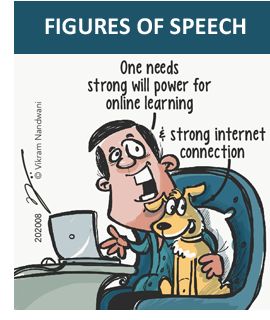
ED: I think these 2 are clichés. While people may feel overloaded by the use of one platform, it is inevitable. What is imperative is a platform, and I believe there are some good platforms available. The platform is like a pipe, and what emerges from it depends on what you put in it: oil, water, or waste. If the content is good then there's definitely every opportunity for it to have a superior impact, rather than 'death'. For those who do have access to the technology that makes online learning possible, it's a win: anyone can teach, anyone can learn, anywhere and anytime.
In my experience, it is possible to be very creative in online learning. In this mode, people can respond and participate anonymously, and this anonymity actually enables authenticity. Let me give you a scenario: in a physical classroom when you have eye contact with participants and ask them how they're feeling. It is likely that you will get positive and affirmative responses. Whereas when I asked a virtual class the same question through a poll, people used words like 'annoyed', 'irritated', and 'tired', which made me aware of their state and gave me the opportunity to recognize and respond accordingly. It is an interesting challenge for a facilitator as she/he has to be alert, aware, and responsive.
In physical classroom settings, for class participation, at best I would allow 3-4 participants to respond to a question. But now, it is possible for all participants to ask a question at the same time or respond to a question at the same time. There is an opportunity for these platforms to have a backend AI to categorize the responses and/or do a sentiment analysis of participants' textual responses, thereby enhancing the quality of learning and shared experience.
ET: As companies pivot to online remote work, online employee engagement practices will be the key to bridge training needs. How will technology enhance this experience further?
ED: If you look at the three basic employment segments: agriculture, manufacturing, and services, work from home is an impractical prospect for different sectors. Agriculture cannot work from home, and neither can manufacturing, except their leaders and managers. Even in services, it is those who work with information that have the opportunity to work from home. So, this is possible only for a section of society, rather than being universal and it is important we keep this in mind. Having said that, engagement of those who are working from home is extremely critical. If engagement is one side of a coin, accountability is the other.
The key here is to create a safe working culture, especially since we are physically distant. The role of a leader is to define outcomes and goals and facilitate adequate resources to deliver. For example, I've made available Wi-Fi dongles because connectivity was an issue for some where they stay. Further, laptops have been replaced in situations where colleagues found them to be inadequate.
Leaders also need to be aware that while their connection is with the employee, their voice is amplified to the family. Therefore, they do not have control on what is said or unsaid, or how it is all said. There should be reasonable transparency of information on their end. This enables a two way information exchange. It's amazing how team members can collaborate with each other and deliver shared goals.
Empathy and recognition are two aspects which need to be fostered. We had an evening 'dessert' a few days after the lockdown began, where one colleague was chosen for the dessert and everyone shared what they appreciated about her or him. Since this was on an online meeting platform, it was possible to record the same. The colleague who received the dessert nominated someone for the next day. This created a lot of positivity and team bonding. Recently, for a colleague who was leaving for higher studies, team members put together a nice quiz about her which created some very unique memories.
ET: How do you see the future of L&D and what is your advice for cultivating a learning culture for forward-looking organizations?
ED: I see a lot of opportunity for L&D to be impactful. Firstly, L&D needs to create a culture of learning, which can foster curiosity and provide a 'pull'. Learning is done better through a pull than a push. If L&D professionals are able to communicate current realities and preferred futures in an articulate manner, it is likely that their constituency will embrace learning.
An important shift is needed to be made from employment to being made employable. The onus needs to move to employees to upskill themselves. With all employees co-owning their learning, a learning culture will be created. It is made possible with learning experience platforms and learning management systems to give the right nudges. Enabling them to consume bite sizes learning will help turn learning into a marathon rather than a sprint. For example, Coursera recently offered a set of courses for free for corporates. My whole team picked out one course and are doing it together, and this is bringing about team members sharing what they're learning and the value they are seeing in it. This even facilitates stragglers to pull up their socks.
The most delightful thing is the liberating impact of learning. When I meet with participants at the end of every program, there is a recurring question from many of them - "What's next?". This question brings a smile to my face each time and stirs my heart. I ask them back, "Was this top of your mind before you came to TMTC?" and usually they reply - "No". As that response reveals, one of the signature values we seek to create at TMTC is to ignite the human curiosity to learn. I therefore make the appeal to them each time this comes up, to keep that spirit alive.
ET: As a veteran human resources professional and Head of Tata Management Training Centre, perhaps the premier Corporate University in India, can you share some best practices initiated by your organization to help Tata firms build capabilities in these trying times?
ED: I read a quote by an American poet, James Russell Lowell, which reads: 'Mishaps are like knives that either serve us or cut us, as we grasp them by the blade or the handle.'
Keeping this in mind while facing new challenges has been key to how TMTC has adapted. As you are aware, the Tata Management Training Centre is the oldest corporate university in India and has the distinction of being the second oldest in the world. It has been an oasis of learning as well as known for its hospitality. To keep up the services, we have been providing and adapting to rapidly changing workplace contexts; shifting online was imperative even prior to the pandemic. In 2019, we set in motion plans for going digital to onboard a learning management system and a learning experience platform, targeting May-June 2020 to go live. The pandemic only accelerated our efforts and the first week of April this year saw us having a series of test runs on the online platform.
Our webinar series 'Learning Latitudes' debuted on April 9. Since then, we've delivered 86 webinars with 15k unique attendees having a cumulative of 45k participants. I'm also pleased to say that the Tata Group has the highest enrolments for the courses globally under Coursera's initiative, 'Coursera for Employee Resilience', which is free to companies all over the world.
We've also carefully created a calendar for the year taking inputs from key stakeholders and released it a couple of months ago. In order to encourage self-paced learning, we have created learning journeys on 25 pathways on the themes of 'Future Ready and Future Engaged'. We continue to deliver our flagship leadership programmes online but with the same content and rigour. At the backend, there has been a lot of engagement with facilitators and faculty partners on the use of online learning platforms and tools like menti.com to ensure that the learning experience is impactful.
Overall, my reflection on this shift is as follows. In a physical setting, in addition to content what also got communicated was context and the intent. Whereas in an online setting, content is definitely given, but effort needs to be made so that context and intent are understood. This, I believe, is where the opportunity lies to be creative and impactful.
back to top ^
|










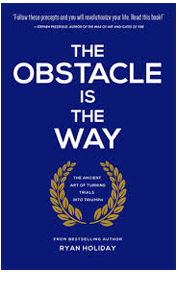 This is an inspiring book and very apt in the times we are in.


 The ELS Lotus logo is trademark of Empowered Learning Systems