|
|
|
|
| |
Dear Reader,
Corporate Social Responsibility (CSR) and sustainability have long been the buzzword for businesses. The adoption of CSR and sustainability is intended to have a positive influence on the world as businesses continuously looked at options to operate in ways that enhance both society and the environment.
However, at a time where climate risks (and now the pandemic) continues to impact human lives and all aspects of work, the concept of Environmental, Social, and Governance (ESG) has gained traction and is attracting the likes of investors, regulators, international agencies and businesses. With ESG, the focus has shifted from a purely outward-looking analysis to a more dynamic approach focusing on both internal and external factors of an organisation.
ESG as a subject in India is still in its nascent stage. However, climate change, the loss of biodiversity, the pandemic, social unrest, among other reasons, are calling for the quick adoption of actionable ESG practices. Indian regulators are gradually taking concrete steps to put India onto the global ESG map through various initiatives while promoting ESG risk management in India Inc.
ET this month throws light on the 'ESG Risks'.
On the Podium, Sankar Chakraborti Group CEO of Acuité Ratings & Research and Chairman of ESG Risk AI, draws our attention on the importance of ESG and the various practices in India that are helping to address pressing world issues.
In the Thinking Aloud segment, Jay looks at the fact that companies are waking up to the ESG call while the scrutiny and assessment of these ESG initiatives are examined. In the We Recommend section, we review Sucheta Dalal's & Debashis Basu's book - 'Absolute Power', which gives readers an inside view of the success stories of the National Stock Exchange while running parallel stories of the several mega scams that shook investor confidence at the time.
In Figures of Speech, Vikram's toon redefines ESG!
Please also Click Here to check out our Special issue of ET, which is a collation of selected themes that were featured over the years highlighting the changing landscape of the business world. This special edition has been well received and can be Downloaded Here for easy reading and is a collector's item.
As always, we value your opinion, so do let us know how you liked this issue. To read our previous issues, do visit the Resources section on the website or simply Click Here. You can also follow us on Facebook, Twitter & LinkedIn - where you can join our community to continue the dialogue with us!
|
|
|
|
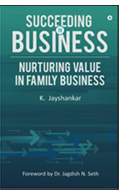
Out Now!
Succeeding in Business: Nurturing Value in Family Business
What makes some family businesses grow from strength to strength? How do you ensure that value is created and not destroyed when a business passes hands from one generation to the next in the Indian context? How can old families incorporate new ideas to revitalize themselves? Is there a role for professional management in Indian family business?
This book offers answers to the vexatious issues that families face in their growth journey. The pointers provided can be used as a guide for nurturing the business and to leverage the traditional strengths that family businesses possess. As a counsellor and trusted advisor, the author, K. Jayshankar (Jay), has had a ring-side view of how family businesses have functioned. The practical insights drawn from his experience of four decades has been combined with conceptual elements to become a valuable primer for a family that wishes to succeed in the competitive marketplace that is India.
|
|
Click below to order your copy now


Special offer for Empowering Times readers. Get 30% discount by using coupon ETSPECIAL on the Notion Press online store.
Click here to connect with Jay.
|
|
|

|
|
The deep linkage between Business and society is now a subject of active interest in corporate circles. Yet, the idea is not new. Over a century ago, the doyen of Indian industry, Jamsetji Tata had famously said, 'In a free enterprise, the community is not just another stakeholder, but is in fact the very purpose of its existence.'
It has taken decades, and a host of corporate misadventures, before realization of the true essence of this nugget of wisdom from a wise businessman. The ideas he spoke about (and put into practice by the House of Tatas), seem counter-intuitive at times, but rarely have global business houses actually lived upto these ideals. The landmark work – Cannibals with Forks: The Triple Bottom Line of 21st Century Business, by John Elkington in 1997, created a fresh wave of interest in business circles, as by this time Elkington's Triple Bottom line (3 Ps - People, Planet and Profits) had been adopted by Shell in its now-famous Shell Report. As in any innovation cycle, apart from the pioneers and the early adopters, the rest took a while to wake up from slumber before they realised that mammon alone cannot be the god for businesses to worship.
In India, while a few firms took the lead (think Infosys), others followed suit and now the regulatory mandate has sought compliance for sustainability reporting from the top 1000 listed companies by market capitalisation from Fiscal 2023 onwards. The Securities and Exchange Board of India (SEBI) has created a new Business Responsibility and Sustainability Report (BRSR) format that brings to the fore environmental, social, and governance (ESG) issues, thereby bringing financial and sustainability considerations on par for the future.
Is there cause for alarm in corporate circles? I believe that the debate about relevance of the Triple Bottom Line have been silenced to a large degree by the sudden pandemic which disrupted the world. Suddenly, the blind quest for money/profits seemed trivial and short-sighted as real life-and-death issues became numero uno in everyone's agenda. There is nothing better than a global crisis to shake one out of inertia and galvanize governments, businesses, and society at large, to pay attention to Gaia's call to fight climate change, pestilence, and wide-spread income disparity.
By bringing the serious conversation on ESG to the Board room, companies are now compelled to ask questions of how they are causing damage to the planet, and what steps they need to marshal to play their part in creating balance and contribute to sustainable development of mankind. The last year has seen more human beings reaching the frontiers of space, but this exploration is still within the domain of the uber rich. The reality is that even for them, there is no Planet B, and protecting this earth, by heeding mother earth, is everyone's responsibility.
Sceptics still abound and there are perverted attempts to 'greenwash' by jumping on the environmental platform and score brownie points with consumers (many multinational firms have been guilty of this through smart and vague advertising, by claiming everything to be a green action) but the good news is that the younger population across the world has been upping the ante through bold calls on politicians to wake up to the new reality around them.
However, if there is one thing that companies understand, it is the money game. A McKinsey study highlighted that there is substantial evidence to indicate a positive correlation between ESG scores and financial results. Significantly, the clincher was that 'a better ESG score translates to about a 10 percent lower cost of capital' as it indicates that business risks are better contained by focusing on ESG factors. To businesses everywhere, there can be no better rational for ESG adherence!
While ESG investing has grown rapidly and 'green money' is the sustainable currency of choice, what is also emerging is close scrutiny and assessment of claims made by firms, as everything cannot be accepted at face value. Be that as it may, this is one business innovation that should endure and not fade away as many management fads have done over decades. The price of failing to adhere to the 3Ps would be catastrophic, as we are being rudely reminded by climate change events around the globe.
Time now to bring to life the spirit that J N Tata spoke about so many decades ago.
back to top ^
|
|

|
|

At Acuité, Sankar leads the company's transformation from being the world's first SME focused credit rating agency to a technology and innovation driven global knowledge company. Acuité has completed rating of over 58,000 entities.
Prior to Acuité, Sankar worked for CRISIL, Centre for Monitoring Indian Economy (CMIE) and Capital Market Magazine. He was part of the founding team of CRISIL Research and CRISIL's Bank Loan Rating businesses. He was also deputed to S&P's Tokyo office in 2006.
Sankar is a sought-after speaker at universities, seminars and thought leadership forums. He aims to assist businesses make informed and better decisions to achieve profitable growth, and to help bring in transparency to financial transactions, through independent & unbiased opinions. He firmly believes that trust, innovation, and excellence are the three values of a rating agency which is going to keep it relevant and meaningful in the coming decades.
Sankar holds a Master's in Business Management and is a graduate in Physics.
ET: Environment, Social and Governance (ESG) as a concept is still in its nascent stages in India. Why is ESG as a concept gaining importance?
SC: Sustainability as a concept was gradually gaining momentum, but a series of events accelerated the concept of ESG in the last 2-3 years:
- Ratification of the Paris accord - COPS 26 - India's commitments made by our Prime Minister towards achieving Net Zero
- The pandemic
- Climate change events over the last 3 years
- Extreme hunger and poverty
- Displacement of populations
Various countries across the World initiated policies and regulations around ESG. The United Nations initiated 17 Goals and targets – the UN SDGs. India being a signatory to various initiatives is one of the first countries to introduce this via regulations. SEBI took the lead in initiating BRR disclosures for the top 500 companies and now introduced Business Responsibility and Sustainability Report (BRSR) for the top 1,000 listed companies. They have also introduced a white paper for ESG Mutual Funds, and we can expect some regulation around it, soon. All of this has accelerated the process for adoption of ESG practices in India.
ET: What are ESG ratings and why are they important? Since ESG Rating is not mandatory why should Indian companies subscribe to ESG ratings?
SC: ESG ratings are a tracker and barometer of a company's ESG performance. This evaluation is a continuous process, where based on our detailed taxonomy, we assess companies and give them a score and a rating. Our granular analysis also includes peer comparisons and enables understanding of ESG best practices within the industries. We include domestic and international ESG frameworks in our ratings, making it robust and comprehensive.
There are multiple reasons why Independent ESG Ratings are essential, even though there is no regulation around it.
- SEBI disclosures via BRSR are now coming in force. Tracking transparency of disclosures and giving an overview of a company's ESG performance can be done through Ratings.
- Most countries where India is exporting to or companies where we have a transnational presence, have initiated regulations and practices where the principal companies are responsible for ESG compliant suppliers, partners and customers. Global investors have made ESG performance ratings or SPOs (second Party Opinions) as part of their lending criteria.
- Exchanges like BSE – SME and IFSC-NSE (Gift City) have also included these as part of their listing criteria.
Given the above developments, even in the absence of regulation, it is essential for organizations to have an independent and credible ESG rating in order to raise money, get customers and ensure their businesses do not collapse. Having ESG initiatives is one thing but how do we give assurance to investors, clients and regulators as to the efficacy of these initiatives? Only an independent rating process can achieve this objective.
ET: SEBI is seeking to tighten the disclosure, strategies and practices of funds based on ESG. How will this impact India Inc. and add to the overall social value & development of the country?
SC: SEBI is taking timely and welcome steps to make compliances and disclosures more robust and stringent. This will force organizations to focus on ESG parameters. Many companies have already set up ESG or sustainability departments which report into the senior management or even the Board. This will improve India's performance on social and environmental parameters. This is definitely a rapid change having a cost impact. But in the long run, the returns will be more than commensurate for organizations as well as society at large.
ET: How can sustainable reporting and ESG assessments help in addressing some of the pressing issues (such as climate change) that the world faces?
SC: Any initiative or work must be monitored to understand if it is being implemented and having some impact. This is where reporting comes in, e.g., BRSR. Anything which is implemented, monitored and reported, has to be measured. This is where ESG Ratings and assessments come in the picture. To give an example: A company has put in a wastewater re-cycling plant. You will get to know of it, if you report it. But to know how much of wastewater is recycled and is it above or below industry / required standards is a metrics-based assessment. This can be done by an ESG assessment process.
ET: Can you tell us about your company ESG Risk Assessments and Insights Limited and some of the initiatives that have helped develop the ESG framework in India?
SC: ESGRisk.ai is part of the Acuite Group. The parent company Acuite is promoted by Dun & Bradstreet, SIDBI, SBI, Standard Chartered Bank and other PSU Banks. We are SEBI registered and RBI accredited.
ESGRisk is India's first ESG Rating agency and assessed top NSE 600 Companies already. This is the highest ESG coverage in India. We soon plan to take this up to 1000 companies. In addition, we also provide ESG assessments to Unlisted Companies and SMEs. We have recently launched Independent ESG SPO for Bonds & Debt Instruments. Our Gap analysis services assist companies to identify critical gaps in their ESG framework and provide a roadmap for continuous improvement. We will continue to supplement our ESG portfolio with different products over time to address different market needs.
back to top ^
|
|
|
 |
Mumbai Roti Bank, a non-profit, food rescue organization initiated by Roti Foundation, Mumbai, bridges the gap between hunger and excess food. Started in December 2017 under the able mentorship of former Director General of Police, Maharashtra, Mr. D. Sivanandhan, the organization aims to eliminate hunger, malnutrition and food wastage, many meals at a time. Help make a difference by calling +91 86555 80001 to donate food or by making a contribution.
|
|
|

|
|

In recent news, the National Stock Exchange (NSE) of India emerged as the world's largest derivatives exchange for the third consecutive year in 2021 in terms of the number of contracts traded, according to the Futures Industry Association (FIA). The Exchange was ranked fourth by the number of trades in cash equities for 2021, as per the World Federation of Exchanges (WFE). These statistics are a matter of pride for an exchange that came to be in 1992, as an alternative to the dominant Bombay Stock Exchange (BSE).
Sucheta Dalal and Debashis Basu chronicles how NSE transformed India's growth story in the capital market but took a turn and allowed itself to be ripped off extraordinary profits from investors and intermediaries, get away with poor risk assessments and quite shrewdly work itself out to avoid paying any compensations in lawsuits.
The book brings to light the stark reality of how the NSE, over the last two decades, has used its power and dominance to crush competition and buy influence. Under Dr. R. H. Patil, its first Managing Director, NSE led the transformation of the stock market to one of the best and safest in the world, within five years of its launch.
At the heart of the book is the elaborate, behind the scenes look at the 1992 Harshad Mehta scam which featured an embezzlement of US$ 3 billion that led to loss of wealth in the life savings of many investors. Further, the co-location (Colo) scam between 2013 and 2014 were allegations that some brokers who had leased space at the NSE co-location facility were able to log on to the NSE's systems faster while engaging in algorithmic trading, which allowed them unfair access and advantage. Many technical glitches followed these scams over the years, with the SEBI sending out show-cause notices to the Exchange.
The book is investigative journalism at its best, leaving no stone unturned. The authors are of the opinion that the way forward to ensuring a clean and transparent exchange is two-fold. First, ensure that NSE has meaningful competition. Second, make all stock and commodity exchanges subject to the Right to Information Act.
The booming business and profit of NSE continues to hide the state of its regulatory function. Between November 2019 to March 2021, NSE registered a stunning 21 broker defaults. The defaults continued in 2021. Earlier this month, the arrest of former MD & CEO of NSE, Chitra Ramakrishna, dampened the sentiments surrounding NSE's accolades, triggering the negative attention that the government had sought to avoid.
All these events continue to raise a lot of questions and highlight the strange paradox of NSE's structural inefficiencies which have been built over the years alongside its extraordinary market dominance. With the economy expected to recover after the pandemic low, efforts are afoot to restore investor confidence in the market. Will the NSE get back to its glorious days of two decades ago? Or will it continue to fall prey to its past self which wielded brute power without accountability? The jury is still out there.
back to top ^
|
|
| |
|
THROUGH THE LENS
|

|
|
In a rare sighting, bird enthusiast, Rupesh Balsara spots the Marbled Duck which is known to breed in the specific regions of eastern and western Mediterranean and Iran. These ducks feed on fish and aquatic plants at freshwaters and wetlands. They also visit open calm waters and temporary wet areas during the winter season. The conservation status of the Marbled Duck falls under the vulnerable category due to the constant decline in their population as a result of habitat loss and hunting.
|
|
|
|
Empowered Learning Systems
www.empoweredindia.com
101, Lords Manor, 49, Sahaney Sujan Park,
Lullanagar, Pune – 411040,
Maharashtra, India


|
 The ELS Lotus logo is trademark of Empowered Learning Systems The ELS Lotus logo is trademark of Empowered Learning Systems
©2022 Copyright Empowered Learning Systems (ELS). For private
circulation to clients and well-wishers of ELS. While ELS endeavors to ensure
accuracy of information, we do not accept any responsibility for any loss or
damage to any person resulting from it.
|
|
|
|
|
|
| |