|
|
|
|
| |
Dear Reader,
The life sciences sector in India is growing, becoming a cornerstone for cutting-edge research and development. The country has a large pool of talented scientists and engineers from indigenous research institutes and academic institutions, who are driving and supporting the life sciences segment in India. Despite this, there are still many challenges that need to be addressed in order to fully realize the potential of life sciences research in India. One of the biggest challenges is the need for increased funding for research and development, along with inadequate infrastructure and limited access to technology.
Moreover, the latest Indian Union Budget for the financial year 2022-2023 provides strong support for the life sciences sector in India. Some of the key highlights of the budget for life sciences include increased allocation for the Department of Biotechnology, the creation of a National Recruitment Agency, and support for innovation in pharmaceuticals.
This month, ET looks at 'The Exciting World of Life Sciences Research in India.'
In the Thinking Aloud section, Jay highlights the need for increased investment in life sciences research, including in India's biotechnology sector. On the Podium, Anand Anandkumar (PhD), Co-Founder, CEO of Bugworks, explains that although life sciences research has improved, there are still challenges to be overcome. In the We Recommend section, we review The Ambuja Story by Narotam Sekhsaria which is an account of the journey of Ambuja Cements and its transformation into an innovative business.
In Figures of Speech, Vikram's toon is caught off-guard with the rise of Superbugs!
Please also Click Here to check out our Special issue of ET, which is a collation of selected themes that were featured over the years highlighting the changing landscape of the business world. This special edition has been well received and can be Downloaded Here for easy reading and is a collector's item.
As always, we value your opinion, so do let us know how you liked this issue. To read our previous issues, do visit the Resources section on the website or simply Click Here. You can also follow us on Facebook, Twitter & LinkedIn - where you can join our community to continue the dialogue with us!
|
|
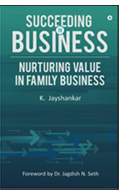
Out Now!
Succeeding in Business: Nurturing Value in Family Business
What makes some family businesses grow from strength to strength? How do you ensure that value is created and not destroyed when a business passes hands from one generation to the next in the Indian context? How can old families incorporate new ideas to revitalize themselves? Is there a role for professional management in Indian family business?
This book offers answers to the vexatious issues that families face in their growth journey. The pointers provided can be used as a guide for nurturing the business and to leverage the traditional strengths that family businesses possess. As a counsellor and trusted advisor, the author, K. Jayshankar (Jay), has had a ring-side view of how family businesses have functioned. The practical insights drawn from his experience of four decades has been combined with conceptual elements to become a valuable primer for a family that wishes to succeed in the competitive marketplace that is India.
|
|
Click below to order your copy now


Special offer for Empowering Times readers. Get 30% discount by using coupon ETSPECIAL on the Notion Press online store.
Click here to connect with Jay.
|
|
|

|
|
The Superbugs are here!
The term 'Superbug' is synonymous with Prof. Anand Mohan Chakrabarty when he invented it in 1971 and then fought a legal battle to patent the oil eating bacteria. Welcomed by industry in its fight against oil pollution, this breakthrough idea in the field of genetic engineering captured the imagination all around, and once again emphasized the potential of the biological sciences to offer solutions to the world.
Let us never forget, however, that science offers miraculous products, but they have to be used wisely. In the hands of the ignorant (or the devious), such tools can cause grave danger too. One such challenge that the world is now witnessing is the rise of 'Superbugs'. Nothing connected with Prof. Chakrabarty, one may add, this Superbug is a scourge that is now threatening to run wild if not addressed seriously.
In simple terms, the Superbugs phenomena that I am referring to is the virulent mutation of bacteria, parasites, fungi, and viruses that have been created due to rampant and ill-advised use of antibiotics. Generally assumed to spread through hospitals, such mutations are proving resistant to the common and well-known therapies, and some estimate that global fatalities have risen over 1.2 million last year.
Once welcomed as a magic cure, the first antibiotic (penicillin) developed by Alexander Fleming, in 1927, gained popularity in the middle of the last century and served as a breakthrough drug that dramatically saved lives. Therein lies the challenge too: its success became the trigger for unbridled misuse when the sniper's gun that had to be used with expertise fell in the hands of others who converted it into an AK-47 that could spray shells randomly and wildly. Of course, in the early years many in the medical world did not quite fathom how this powerful medicine could be used, but the misuse has accelerated in nations where self-medication is the norm and access to antibiotics is easy. Hence, a monster is being bred due to ill-informed negligence.
The challenge now is to find new ways of treating them and a glorious effort is being marshalled in some laboratories across the globe, including India, to find urgent solutions before this reaches nightmarish proportions.
This brings us to the need for investments in advanced scientific research in life sciences. The century we are living in has been called the 'century of biology' and predictions abound that the intersection and potential convergence of biology and technology will give rise to innovative breakthroughs at a pace never seen before. Susan Hockfield (the first woman President of MIT) offered a glimpse of these novel researches in her eye-opening book, The Age of Living Machines: How Biology Will Build the Next Technology Revolution, and to the lay audience, the ideas that she shared created special excitement about a brave new world that we are stepping into - be it tales of scientists crafting virus-built batteries, generating cancer-detecting nanoparticles, designing protein-based water filters, etc.
Indeed, research into life sciences - an umbrella term that encompasses studies the world of living organisms (be it microbes, animals, plants or humans) to create new models, products, applications, etc., that impact agriculture, genomics, the environment, public health, and many other related and associated fields - is a field that attracts many curious minds from multiple fields of learning.
However, what we need is greater research investment in India's life sciences sector. While smug faces may state that India's biotech sector was worth over USD 80 billion in 2021, (reflecting a growth of 14% over the previous year), it is sobering to note that the small nation of Israel raised over USD 2.5 billion for the health tech sector in 2020. And, that is money for just a slice of the life sciences industry.
At a time when ambitious projections are that India's biotech businesses will be worth over USD 150 billion by 2025 (contributing to 19% of the global biotechnology market), there is a great need for cutting edge research investment. Grants from the government alone - and the efforts of intrepid individuals - has to be supported widely by businessmen and venture capitalists who wake up to the fact that there are new frontiers waiting to be explored - and at the same time, 'debugging' could offer immense commercial returns too.
back to top ^
|
|

|
|
 Anand is the Co-founder and CEO of Bugworks, an Indo-USA-Australia biotech start-up, supported by CARB-X, working on tackling the massive problem posed by untreatable bacterial Superbugs which are implicated in hospital/community infections and bio-terrorism situations.
Anand was previously Co-founder and Managing Director at Cellworks, a Bay area and Bangalore based company which is a pioneer in using modeling and simulation to support personalized cancer therapy area. Prior to the biotechnology experience, Anand was a professional in the semiconductor industry with about 15 years of global experience in designing high end Integrated Circuits, chip design and operations management experience in US/China/Japan/UK and India, a globalization specialist in both semiconductor and biotechnology spaces, having co-founded the Indian Semiconductor association and being an Executive council member of the Indian biotech association.
Anand received his Bachelor's degree in Electronics and Communication from College of Engineering Guindy, Anna University, India (1986) and a MS & PhD in Electrical and Biomedical engineering from George Washington University in Washington D.C. (1992). He won the distinguished alumnus award from Anna University in 2016. He is a member of Eta Kappa Nu and Tau Beta Pi, global engineering honors' committees.
Anand is a globally recognized key opinion leader in the Antimicrobial resistance (AMR) Industry and affiliations include Member of Executive committee of India biotech association, Member of India advisory board of GARDp, Board member of AMR Industry Alliance, Advisory Board member of the India AMR Declaration trust, Member of AMR Working Group Bio USA, Co-founder of Indian Electronics and Semiconductor association (IESA), AMR member of G20 health development partnership and speaker in global platforms including the G20, WHO, UN, APIF-Japan, etc. Anand is also Co-founder and mentor to more than 4 biotech start-ups in the Bangalore life-science cluster including Biomoneta, Impres Health and Ignite Life Sciences Foundation.
Apart from health-related initiatives, Anand is very committed to children's upliftment. He is the Co-founding trustee of CHILD Childrens Home in Chennai India, which he has been actively managing since 2006. This home caters to hundreds of children orphaned and abandoned by HIV/AIDS and other socio-economic taboos. Anand is also a Co-founder to Humanist Foundation that takes care of patients who cannot afford Cancer therapies, working in association with Cytecare Hospitals, Bangalore.
ET: Can you please throw some light on the current scientific landscape in India? How does India compare with the rest of the world specifically for research in life sciences?
AA: The current scientific landscape in India is very heterogeneous. There are some areas like theoretical physics and chemistry where we are strong; however, in experimental sciences, we are only slowly gaining ground. Life sciences is an important exception, where considerable stress has been given by the Government of India and we are beginning to do relatively well in agricultural and experimental life science.
According to a recent NITI Aayog report, India's R&D expenditure or R&D as a percentage of GDP has been lower than Brazil and South Africa - which is roughly about $43 per capita. During the last decade, India's gross expenditure on R&D as a percentage of GDP was around 0.7%, much lower than the BRICS partners. So we have a long way to go in terms of investments into R&D, without which we cannot expect scientific ecosystem to solve large problems of our country in agro/health/environment, etc.
ET: What are the challenges that hinder the advancement of life sciences research in India and how can key stakeholders overcome these?
AA: The major problem that is impacting the quality of research in life sciences is the status of education in universities which lack a sound curriculum, trained faculty and good infrastructure that supports experiential learning - a critical attribute to instill a culture of scientific curiosity and enquiry-based learning to drive innovative thinking during the formative years. Unless these aspects are taken care of, it will be difficult, if not impossible, to go to the next stage of developing an innovation driven scientific ecosystem in India. The other major issue is lack of funding, be it from government or private sources. Without adequate funding pools to support local innovation, innovators often have to set up their headquarters outside India in the hope of tapping global funds. Unfortunately, the lacunae in funding has not improved despite the space making so much scientific progress in recent years.
ET: How do you view the contribution of private companies, especially start-ups, in developing & engaging in life sciences research in India?
AA: In a way, private companies, especially start-ups, are taking in many students with Master's and PhD qualifications in life science to augment novelty and develop new products and a sustainable pipeline of innovation. However, the scientific publications from these start-ups are very few as there is no financial incentive for this exercise to gain global recognition and stimulate funding. To go to the next level, start-ups should generate high-quality patents and publications and slowly move away from routine and generic technology and focus on building innovative solutions catering to local needs. Start-ups are the lifeline for life-sciences research and they needed to be nurtured by government, private investors and biotech companies from India.
ET: Antibiotic resistance is one of the biggest threats to global health, food security, and development today. What are some of the innovative and digital/analytical tools that has made research in this field insightful today?
AA: There are a few early efforts to discover novel diagnostics to identify bacteria using microfluidics and spectroscopic methods. We still need more research on how to link bacterial identification with their antibiotic resistance profile in real-time to guide the clinician in prescribing the right choice of antibiotics to treat life-threatening infections.
Therefore, merely pathogen identification will not have much clinical application or relevance in addressing the global issue of antimicrobial resistance. I see AI and Machine Learning playing a huge role in the coming years in the design of new diagnostics and therapies. The coming together of classical pharma methods, AI and Machine Learning will unleash highly innovative ideas in the years to come.
ET: Can you tell us about your company, Bugworks and some of the notable breakthroughs it has achieved? Under your leadership, what are your future plans for the company?
AA: Bugworks is at the global forefront of discovering novel antibiotics and is unique in its scientific positioning to address a variety of infections spanning critical care, public health and bioterrorism threats. We have generated a robust portfolio of granted national and international patents. Our lead antibacterial asset, BWC0977, is in first-in-human phase I clinical trials in Australia. BWC0977 belongs to a novel class of Antibiotics that we have designed called GYROX, which has the potential of becoming the first Broad spectrum novel class of antibiotics in more than 60 years. Our antiinfective solutions have applications in Hospital and Community infections as well as Bio-Defense
Bugworks has also produced several peer-reviewed scientific publications in top-rated international journals and has finally taken the scientific training of its staff to the next level by assisting them in submitting a doctoral thesis based on their novel published work.
For the last three years, we have been working on various targets in the field of immuno-oncology. This brings in another arm to our drug discovery paradigm and an opportunity to address a critical unmet need in developing affordable and novel therapies to target hard-to-treat cancers. We anticipate the beginning of the first-in-human trials of our oncology asset in the next 15-18 months.
back to top ^
|
|

|
|

Gujarat Ambuja, founded in 1983 by Narotam Sekhsaria, is a perfect example of an Indian company that moved with the times and transformed a vision into a reality. The Ambuja Story is an account of how the company came into being at a time when India was dominated by state-owned cement enterprises.
Narotam Sekhsaria shares The Ambuja Story of how he and his business partners came together to start Gujarat Ambuja and the challenges they faced in establishing and growing the company. The company's growth over the next two decades was rapid, expanding its capacity to meet the growing demand for cement in a developing India. The read also provides a unique perspective and challenges including corruption, bureaucracy, and political instability.
The author sheds light on the hits and misses, such as the success story of the acquisition and revival of the erstwhile Modi Cement (renamed Ambuja Cement Eastern Ltd (ACEL)), the unsuccessful attempt to expand cement production in South India (Tamil Nadu) and the unfulfilled dream to set up a cement plant in Jammu & Kashmir. Alongside expansion plans in India, his claim to glory came from the takeover of ACC, a Tata company then. The merger enabled the company to streamline its operations and reduce costs, which improved its profitability and competitive position in the Indian cement market; the ACC stake was sold to Swiss cement company Holcim later. In 2022, Ambuja Cement became a part of Adani Group.
The book is a collection of episodes from Narotam's early life struggles and experiences and also reveals many lesser-known nuggets. When diagnosed early with cancer of the mouth (brought about by years of tobacco use), Narotam humbly cites that his spirituality helped him bounce back to health. It also inspired him towards philanthropic efforts that went beyond donations to NGOs. In 1993, the Ambuja Cement Foundation (ACF) was formed as part of Gujarat Ambuja for community development, instilling the "I Can" spirit everywhere. With his roots in cotton farming and trading, ACF became part of the Geneva-based Better Cotton Initiative, a global not-for-profit organization that ran cotton sustainability programmes. He has received numerous awards and honors for his contributions to business and society, including the Padma Bhushan in 2010. The author also shares the story of how Ambuja Cements became one of the most environmentally responsible companies in India. The company's commitment to sustainability serves as an inspiration to others and shows that businesses can thrive while also having a positive impact on the environment.
Narotam Sekhsaria currently serves as the Chairman Emeritus of Ambuja Cement and continues to be an influential figure in Indian business and philanthropy. This book is a welcome addition to the large number of books that have been written about the rise of Indian business brands in a challenging and competitive economic environment. Today, the business environment of Indian cement companies continues to be highly competitive, with a large number of players operating in the market. Regulations, price volatility, high input costs, and supply chain inefficiencies still plague this industry. Peruse this book to take in a refreshing perspective on the journey to business success, backed by perseverance, integrity, and innovation, despite all odds.
back to top ^
|
|
| |
|
THROUGH THE LENS
|

|
|
Our in-house photographer, Rupesh Balsara spots the Changeable Hawk-Eagle which is commonly found in India and Southeast Asia. This species feeds on small mammals such as squirrels and rabbits. Known for its hunting capabilities, the Changeable Hawk-Eagle is considered to be of "least concern" by the International Union for Conservation of Nature. However, habitat loss and degradation due to human activities are potential threats to the species' long-term survival in India.
|
|
|
|
Empowered Learning Systems
www.empoweredindia.com
101, Lords Manor, 49, Sahaney Sujan Park,
Lullanagar, Pune – 411040,
Maharashtra, India


|
 The ELS Lotus logo is trademark of Empowered Learning Systems The ELS Lotus logo is trademark of Empowered Learning Systems
©2023 Copyright Empowered Learning Systems (ELS). For private
circulation to clients and well-wishers of ELS. While ELS endeavors to ensure
accuracy of information, we do not accept any responsibility for any loss or
damage to any person resulting from it.
|
|
|
|
|
|
| |