|
|
|
|
| |
Dear Reader,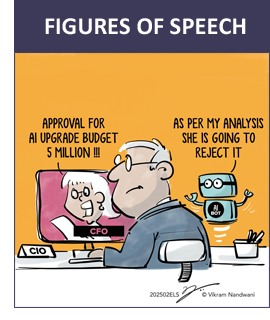
The role of the Chief Information Officer (CIO) has undergone a seismic shift over the years. From being custodians of IT infrastructure, CIOs have become strategic enablers of business growth. Today's CIOs are no longer confined to ensuring uptime or managing systems; they are architects of innovation, collaborators at the C-suite level, and champions of digital transformation.
In an era where digital disruption is the norm, the CIO's responsibilities have expanded to include aligning technology with business objectives, mitigating cyber threats, fostering a culture of innovation, and driving seamless collaboration across organizational functions. They act as visionaries, not just keeping the lights on but paving runways for future innovation.
This transformation demands a delicate balance between operational excellence and strategic foresight. As stewards of change, CIOs must not only deploy cutting-edge technologies but also manage the human side of transformation-building teams, inspiring trust, and driving cultural shifts. Strong collaboration with other C-suite executives ensures that IT is no longer a support function but a core driver of organizational agility and growth.
Empowering Times (ET) this month looks at The Changing Role of the CIO in Guiding Organizational Growth.
In the Thinking Aloud section, Jay traces the evolution of the CIO from an obscure IT role to a key strategic advisor, highlighting the need for business acumen, agility, and collaboration in driving digital transformation and organizational success. On the Podium, M Prabhakar Rao - AVP - IT & IS, NATCO Pharma Limited explores insights on the evolving role of CIOs, their challenges in balancing IT strategy with business growth, driving digital transformation, fostering collaboration, and his career learnings as a leader in IT. In the We Recommend segment, Jay's review of Revenge of the Tipping Point praises author Malcolm Gladwell for revisiting his past work and analysing how small actions fuelled the opioid crisis-a widespread drug problem-but questions whether the book fully embraces the uncertainty he now advocates.
In Figures of Speech, Vikram's rendition of the CIO steering budgets - with robots in the co-pilot seat!
Please also Click Here to check out our Special issue of ET, which is a collation of selected themes that were featured over the years highlighting the changing landscape of the business world. This special edition has been well received and can be Downloaded Here for easy reading and is a collector's item.
As always, we value your opinion, so do let us know how you liked this issue. To read our previous issues, do visit the Resources section on the website or simply Click Here. You can also follow us on Facebook, LinkedIn, X, Threads & Instagram - where you can join our community to continue the dialogue with us!
|

Out Now!
Succeeding in Business: Nurturing Value in Family Business
Click below to order your copy now


|
|
Special offer for Empowering Times readers. Get 30% discount by using coupon ETSPECIAL on the Notion Press online store.
Click here to connect with Jay.
|
|
|

|
|
There was a time when a company had an obscure department in the corner of a floor, away from obtrusive eyes, called the Electronic Data Processing (EDP) Department. A mid-sized room with some tables, it housed a special machine called a computer in an air-conditioned zone where only those with special access were allowed to enter, usually without street footwear, much like an operating theatre or a temple. Nerdy men with glasses manned it, and were tasked by other departments (usually finance, marketing or payroll) to carry out the special instructions given to them. Once they diligently did it, the organization forgot about them till the next cycle of payroll or data processing which was asked of them.
If this picture brings to mind a Dilbertian world of the 1960s and 1970s, it is not wrong. But fortunately, time has not stood still. Business organizations are swamped today with the tiny handhelds (think smart phones) that everyone carries, and laptop bags have replaced the executive briefcases that were once de rigueur in corporations. This transformation has also created a powerful new member in the C-suite, the Chief Information Officer, the CIO. Sometimes the role is synonymous to the Chief Technology Officer (CTO), but larger organizations create distinctive roles with the CIO's ambit being internal technology, IT systems, infrastructure, business analytics, etc., that ensure effective operations of the firm, while the CTO is the owner of innovative initiatives of product and technology development of the business, keeping in mind customer - and - market trends.
What began as implementing enterprise-wide software and ensuring continuity of business operations is now treated as par for the course. The real ask of the CIO is to mine data and crunch the numbers that would reflect both lead and lag measures that are vital to steer a business. Consequently, s/he has become a key advisor to the CEO to navigate the business away from the icebergs that are so common in business waters. This also means that the role requires good inter-personal skills to team up with line departments who are key players to either create the products and services or to woo the customers to generate revenue for the firm. The underlying aspect is that CIOs need to comprehend how a business actually operates, rather than being functional specialists who only speak the language of technology. In this context it is important to draw lessons from the way McKinsey has envisaged the new avatar of the CIO. Stressing that the CIO should be a driver of value in an agile organization, they have suggested five roles: those of a Business leader, a Change Agent, a Talent scout, a Culture revolutionary, and a Tech translator.
While a junior member of the IT team may scarce recognize that there are many angles to his function, the days of being an IT Helpdesk is well past. First, the quality of hardware has significantly improved over the past decades. Coupled with it is the reality that users too are more knowledgeable than the early generation who were almost entirely digital migrants. A new crop has come that is aware of how to fix the few routine glitches that may arise, or they know that a quick visit to a Google site or a YouTube video can be the fastest way to resolve a problem. Besides, with most programs being cloud based applications, the days of storing large data on internal servers is coming to an end. Members of the firm's IT team today have to educate themselves on what their company's goals are in the marketplace, and how they can service their internal customers best so that they can win in the competitive world outside. This requires an agile mindset that they can actually demonstrate and convince their internal colleagues, beginning with the ability to evangelise and excite others with the rapid changes in technology. New tools are on offer almost with regular rollouts, as tech firms bring improvements through Artificial Intelligence (AI) in all standard business activities: conferencing, ensuring effective meetings, calendar updates, communication, storage and quick transfer of data, mining and analyzing historical information for predictive decision making, creating prototypes, et al.
While many senior members of a firm have conceptual awareness about these new tools and techniques that are brimming with promise, the challenge is to display their potential and ensure that the performance is reflected inside their firm through customized solutions. Helping line managers unlock this promise calls for proactive work through the IT function. The CIO has to train and develop his team to become change agents who can permeate across the firm, tackling entrenched members who find it difficult to move away from the status quo that has given them safety and relevance in the firm. I envisage a CIO who is a close collaborator of the CHRO to transform the organization's culture, making it agile and effective.
It is now well accepted that we are on the crux of an AI-led transformation of the world. It is inevitable. It is time therefore for CIOs to shed their inhibition and seek a stronger stake in business transformation. It has been believed that the CFO and the CHRO have been the two arms of the CEO and his closest advisors. No longer is this acceptable. It is imperative that the CIO should also be in the inner cabinet to guide the CEO to keep the firm relevant in the face of the strong winds of change. Navigating through the approaching storm needs teamwork, admittedly, and a competent CIO has the skill to make sense of the turbulence and ride the choppy waves. The onus is on him to make himself heard and prove his relevance.
back to top ^
|
|

|
|
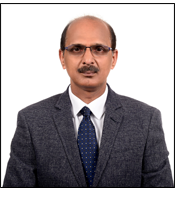 M Prabhakar Rao is an experienced IT & IS leader with over 35 years of expertise in driving technological innovation and business transformation. Currently serving as Associate Vice President - IT & IS at NATCO Pharma, he oversees strategic IT initiatives to enhance operational efficiency, compliance and business performance.
Throughout his career, Prabhakar held leadership roles in IT and Supply Chain Management and Consulting, at companies like Indian Immunologicals Limited, GVK Biosciences, and Acuvate Software. He started his career with Merind Limited and worked with Colgate Palmolive (I) Limited. He led major projects like SAP upgrades, e-commerce model integrations, and advanced enterprise solutions, aligning technology with business objectives.
Skilled in IT strategy, ERP systems, Business process optimization, and Digital transformation, Prabhakar brings a results-driven approach to every project. He is passionate about building teams and leveraging technology to streamline operations, foster innovation, and drive growth.
ET: How has the role of the CIO evolved in recent years, especially within pharma companies?
MPR: From the early days of EDP (Electronic Data Processing) to today's IT (Information Technology), the department has transformed into a vital and interconnected part of any organization. It is no longer just a back-office function, where hours of downtime had minimal impact. Today, even a few minutes of internet disruption can halt operations and affect organizations significantly. Previously, a day or more of downtime was manageable for an EDP head, but now, minutes of downtime can disrupt business transactions, making the CIO accountable to all stakeholders.
Beyond ensuring the uptime of IT components like LAN, WAN, and critical applications, the CIO must also drive new projects, identify opportunities that add business value, reshape the IT landscape, mitigate threats, address vulnerabilities, enhance cyber security awareness, and maintain seamless communication across all organizational levels—all while ensuring the business runs smoothly.
ET: What key challenges do CIOs face in balancing IT strategy with business growth objectives?
MPR: The CIO's role is akin to preparing an airport runway for various types of aircraft—helicopters to wide-bodied planes—ensuring readiness for diverse demands. Similarly, CIOs must align organizational goals with IT infrastructure, skills, and capabilities in a rapidly changing environment. They need to balance the organization's needs, skill development, regulatory and statutory compliance, while staying focused on innovation and security. Throughout, the C-I-A triad—Confidentiality, Integrity, and Availability of information—must remain intact.
ET: In what ways can a CIO drive cultural change within an organization to embrace digital transformation?
MPR: "Change with Change, or else Change will change you" is a mantra that resonates with organizational transformation. Humans are naturally resistant to change, so strong conviction in its benefits is essential to persuade others. Minds must be conditioned, and the value of change made evident.
Change management is a process that should be well-structured and inclusive. CIOs must recognize that any change typically passes through three stages: 1) ridicule, 2) vehement opposition, and 3) acceptance as self-evident. Conviction, coupled with clear and compelling communication of the benefits to stakeholders, is key to driving acceptance.
ET: How important is collaboration between the CIO and other C-suite executives in guiding organizational growth?
MPR: The CIO's are the glue in the organization and they have to be central to all activities. The CIO's must ensure that the current business is delivered through delegation to the next level and new innovations are driven by the CIO from top or the C-Suite. In other words, while the team works on the day-to-day activities and ensures that the lights of the business are "ON", the CIO is should focus on strategic objectives by collaborating with the top management and aligning IT strategies with the business vision and for the accelerating the growth.
ET: Please share the learnings in your career journey as an Information Technology professional from the early days of computing to your current role now where you are the CIO leading digital transformation at NATCO.
MPR:
- Learning - Every day, there is a new thing and we have to keep abreast of the developments. Learning is a journey and the destination is only when the breath stops. All other qualifications, certifications, skills are mere milestones which we cross one by one. IT is a vast ocean and it is impractical to know everything considering the pace at which the developments happen. It is not at all static. We must keep ourselves updated or else just as the IT assets/ technology, we run the risk of obsolescence. My float has been my learnings over the years and I bank on the same.
- Management Vision and Support - The top management's support and vision are very important to drive the initiatives and the CIO's role is to show the value to the top management to trust and invest in such initiatives. My Team and I at NATCO enjoys that unwavering support from the management in the initiatives.
- Delegate - One of my early learnings from Mr K V Balasubramaniam - delegate what you know and learn what you do not know. I believe in delegating to my team and cherish the results delivered by the them. It is a great feeling to see the team deliver and the happiness reflected on their faces on such achievements.
- Teamwork - Trust yourself and the team - give them the freedom to think and they will deliver.
- Lead teams, not manage teams - Building teams and seeing the teams work in autopilot mode brings great satisfaction, rather than micromanaging teams. In IT especially that freedom to operate should be given for the best results. The team at NATCO is matured, and are self-motivated and take onus of the responsibility assigned to them. In my current role, the team discharges their responsibilities, and my role is to pave the way for new ideas or change orbits to chart new areas. In a nutshell, I believe that if I am there, I will add value, or else the show would go on!!
back to top ^
|
|

|
|
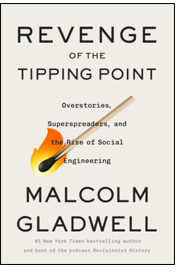 In a recent TED Talk, Malcolm Gladwell was candid enough to offer a public apology of what he thinks he got wrong in his hugely successful book which made him a celebrity author. The book that made him famous, 'The Tipping Point: How Little Things Make a Big Difference', has brought the phrase to common language, and with the passage of time, a quarter of century to be exact, Gladwell decided to revisit his work and discovered a gaping hole in it. Now, it takes a rare individual to go public with his error, and it speaks volumes of Gladwell's humility and commitment to deep research that he turns the spotlight of scrutiny to his own work and discovers that he was not blemish-less.
Gladwell calls 'The Tipping Point' 'the biography of an idea' and suggests that his book highlighted that 'ideas and products and messages and behaviors spread just like viruses do'. He stressed that 'in social epidemics little things could make a big difference'.
Gladwell's latest offering - Revenge of the Tipping Point - has more than a tinge of mea culpa in it. Slightly dissatisfied with his past work, he positions this new book as 'an attempt to do a forensic investigation of social epidemics'. But one may ask, why 'revenge'? Gladwell's answer, 'the very same tools we use to build a better world can also be used against us'. And, the epidemic that he is studying: the opioid crisis that has become a battle for America's soul. Consider this: in 2023 over 8 million patients are reported to be misusing prescription opioids in America, resulting in over 80K deaths. A Harvard study states that the trigger for this crisis began in the mid-1990s with Purdue Pharma's aggressive promotion of OxyContin (with aggregated sales revenue of over USD 35 billion over two decades) and now there are other more potent drugs, chiefly Fentanyl. Gladwell's revenge: a forensic analysis of the opioid crisis - and how the trail leads to the Sackler family's greed, veiled under charitable and philanthropic deception.
Thus, he leads us through a maze of events, activities, examples and well-researched anecdotes to weave a tale of how the opioid crisis in America was a carefully crafted and deliberate action by a bunch of grubby businessmen in the employ of the notorious Sackler family, the superspreaders of the drug menace with the OxyContin pain therapy. The infamy associated with Purdue Pharmaceuticals is well-merited in Gladwell's telling, as the business hired the best minds in the country (aka McKinsey) to fine tune their strategies in their quest for usurious wealth, never mind the consequences to patients. (Aside: Earlier in December, McKinsey came to a settlement with the US Government and agreed to pay a fine of USD 650 million for its part in helping Purdue turbo-charge their sales. Besides, they have also stated that they will not work with any clients for opioid related business).
What makes Gladwell different from us is his unique ability to dig deep into a variety of seemingly straight-forward situations, find linkages and dramatically connect them into an overstory. Searching for a shared set of social norms, standards and traditions, Gladwell paints a picture where there is an implicit correlation between events. The masterly fashion in which he makes his case is much like a trial lawyer who judiciously presents each facet of evidence until the mountain of data compels you to conclude with a guilty verdict. It is Gladwell's thesis that behaviors in society or social epidemics, to use his term, are the outcome of activities or actions engineered by a few remarkable individuals who tip the scale. It might seem difficult to comprehend when the avalanche hits us - but there is no denying that some patient and persistent sleuthing can reveal when the first stone started rolling downhill.
The canopy covers the foliage below and only a diligent explorer can discover what lies beneath. To prove his point, Gladwell weaves a tapestry of mini-stories with multiple characters drawn from various disparate episodes - bank robbers, medical events from small town America, Waldorf schools, Medicare fraud in Miami, Palo Alto inter-racial housing, Harvard women's rugby team, etc. - to reveal that the overstory is as vital as the underlying issues.
The book is certainly not Gladwell's best. But trust him to make it an easy read in the journalistic style that he has always adopted. But at the end, my mind goes back to his comments in the TED Talk, 'I was way too certain about the ideas that I was putting forth. And I thought if you wanted to win over an audience you had to communicate certainty. And now I realize that it is actually backwards, that you're more willing, you're more capable of winning over an audience when you admit to the uncertainty and the fragility of your position … people are likely to be suspicious of someone who seems falsely certain.' Does the book meet this standard? I am not certain that it does.
back to top ^
|
|
| |
|
THROUGH THE LENS
|

|
|
Nature photographer Rupesh Balsara captures a stunning image of the Lesser Sand Plover, a small migratory shorebird found along India's coastal regions. These birds travel long distances from their breeding grounds in Central Asia and Siberia to India's wetlands and beaches, where they feed on small invertebrates like insects, and crustaceans. However, they face threats from habitat loss, human disturbances, pollution, and climate change, which are shrinking their feeding and nesting areas. Conservation efforts are crucial to protect their fragile ecosystems and ensure their survival.
|
|
|
|
Empowered Learning Systems
www.empoweredindia.com
101, Lords Manor, 49, Sahaney Sujan Park,
Lullanagar, Pune – 411040,
Maharashtra, India


|
 The ELS Lotus logo is trademark of Empowered Learning Systems The ELS Lotus logo is trademark of Empowered Learning Systems
©2025 Copyright Empowered Learning Systems (ELS). For private
circulation to clients and well-wishers of ELS. While ELS endeavors to ensure
accuracy of information, we do not accept any responsibility for any loss or
damage to any person resulting from it.
|
|
|
|
|
|
| |