|
|
|
|
| |
|
Dear Reader,
At a time when agriculture sits at the intersection of tradition and transformation, India's farmers are rewriting their own narrative. They are no longer passive recipients of monsoon luck or policy cycles - they are innovators, entrepreneurs, and change makers. Whether it's embracing digital tools, experimenting with climate-smart practices, or engaging in global policy dialogue, the Indian farmer today is as much a stakeholder in the future as any tech founder or policymaker.
But the path is not without hurdles. Regulatory bottlenecks, fragmented landholdings, and inconsistent access to modern technology continue to challenge the pace of transformation. Yet, from the fields of Tamil Nadu to the boardrooms of global networks, voices like V. Ravichandran remind us what is possible when resilience meets reform.
This month, Empowering Times (ET) explores 'The Farmer's World: A Progressive Outlook to the Future'.
In the Thinking Aloud section, Jay reflects on the deep-rooted and politically fraught challenges facing Indian agriculture, arguing that while progress is slow and uneven, the combination of climate urgency, technological promise, and farmer optimism may finally push the sector toward long-overdue transformation. On the Podium, V. Ravichandran, Global Director of the Global Farmer Network, emphasizes the need for science-based agriculture, policy reforms, and youth leadership to drive a resilient, technology-enabled future for Indian farming within the global agri-value chain. In the We Recommend section, Ramona Parsani reviews Indomitable, the candid memoir of Arundhati Bhattacharya, where she chronicles her journey from small-town India to the helm of SBI - offering a quietly powerful reflection on leading with resilience, humility, and purpose in a system not built for her success.
In Figures of Speech, Vikram's toon eyes the future from the field!
Please also Click Here to check out our Special issue of ET, which is a collation of selected themes that were featured over the years highlighting the changing landscape of the business world. This special edition has been well received and can be Downloaded Here for easy reading and is a collector's item.
As always, we value your opinion, so do let us know how you liked this issue. To read our previous issues, do visit the Resources section on the website or simply Click Here. You can also follow us on Facebook, LinkedIn, X, Threads & Instagram - where you can join our community to continue the dialogue with us!
|

Out Now!
Succeeding in Business: Nurturing Value in Family Business
Click below to order your copy now


|
|
Special offer for Empowering Times readers. Get 30% discount by using coupon ETSPECIAL on the Notion Press online store.
Click here to connect with Jay.
|
|
|

|
|
Ask any politician, and he will confirm that the 'Jai Kisan' slogan works wonders during election time. Gallons of tears are shed about the plight of the rural sector, and farmers' distress is an oft-used narrative to gather electoral support on their behalf. Yet, the saga never ends.
It is accepted that after 75 years of independence, the percentage of India's GDP coming from the farm sector has dramatically reduced from the 50–54% share (of 1947) to the current level of 16–18%, but the sector continues to provide sustenance to about 46% of India's population. The target for the Viksit Bharat of 2047 is 7–8% (with 30% of the workforce expected to be in this sector) - still high when you contrast this with the current figures for developed nations across the globe: the contribution to GDP in the US and Japan is approximately 1%, with the numbers for the European Union and China being 1.5% and 7%, respectively. Clearly, there is a challenge that needs addressing, especially when you consider that developed nations are historically built through rising contribution to the economy from the industrial and services sectors. I have no desire to enlist the numerous reasons why productivity challenges of Indian agriculture continue even after the launch of innumerable programs by various Central and State governments over the decades.
It is indeed deeply sad to note that the national average monthly income of an Indian farming household is Rs. 13,661 (as per 2021–22 figures). To quote a December 2024 headline in a popular magazine: "Farming yields Rs. 4,500 a month, less than what you'd splurge on a dinner date," with the rest coming from non-farm jobs. In 2016, when the central government set the goal of doubling farm income by 2022, it was considered ambitious - but a necessary one. Covid derailed many plans, but even in 2025, it seems a bridge too far, despite a plethora of schemes launched of varied nature (policy, technological, financial, insurance-related, etc.). It is not as if there is no forward movement, but the overall numbers are too large, and the arena is a political minefield that extracts a heavy toll from those who attempt to navigate through it. The central government is still licking its wounds from its last attempt to bring structural reforms in the marketing of agricultural products and related pricing.
Another cause for worry is that like in many other fields, there are significant regional disparities in farm income. The average monthly farm income varies from high numbers like Punjab's Rs. 31,433, Haryana's Rs. 22,841, Meghalaya's Rs. 29,348 to the low numbers from Jharkhand (Rs. 4,895), Odisha (Rs. 5,112), Bengal (Rs. 6,762), and Bihar (Rs. 9,252). This wide range is consequently reflected in all other socio-economic development indices too. This only buttresses the argument that there is a systemic challenge that requires committed and sustained multi-pronged initiatives in governance for tackling this hydra-headed monster that prevents national growth.
While it is widely acknowledged that farming in India is a gamble with the odds staked against the farmer (be it through climatic forces, regulatory issues, financial access, market for products, resource optimization, etc.), like an addicted gambler, the farmer refuses to take control and break from the systemic chains that bind him. Is it helplessness, ignorance or inertia (or all these put together, and more)? The slow pace of change is widely decried, but the dice game continues. The voice of progressive farmers is not loud enough to drown the traditionalists who fear a radical break from the past. While it is not my case that the Indian farmer resists change (digitization is a reality, and has been embraced by the farming world), like all other sections of our hide-bound society, change creeps upon them, but is not welcomed with alacrity.
However, there is one looming crisis that may well accelerate the forces of change: climate crisis. Agrarian societies like ours are the first to recognize that nature is on the warpath, and things no longer operate the traditional way. When patterns change, a new world comes into existence, it is said. Seasons are not in sync any longer, and with disruptions galore in society, modifications are becoming a necessity. Coupled with natural forces are other social aspects, as youngsters are not attracted by farming, which is seen as low-income generating, and lacking social status in comparison to urban living with the promise of immediate benefits (even though it extracts a high social price). The advent of techno-commercial angles with their promise of higher productivity (through better seeds, plant protection, insurance, etc.) and confirmed returns (through contracted deals) will perhaps serve as incentives to move away from old notions that have held back advancement. One thing that augurs well is the degree of optimism that has been displayed by the farming community in India. A recent McKinsey report highlights that '76 percent say they anticipate higher profits over the next two years, with more than 65 percent citing improved yields and higher crop prices as catalysts. This is a substantial improvement over 2022, when just 37 percent of farmers expected increased profits.'
The rise of Farmer Producer Organizations (FPOs) has also been a welcome development. Aided by the change in the regulatory framework, the first FPO was registered in 2003–04 (the Farmers Honey Bee India Producer Company Ltd.) and today we have over 44,000 FPOs which are riding on the power of the collective to reduce costs, adopt technology, and gain other benefits of scale. While they have their own set of tribulations to tackle, they have been largely successful, with the highest number being in Uttar Pradesh (1,275 FPOs). This is a good trend, as the model enables the small and marginal farmer to access resources of various kinds that he could not have done singularly.
Modern agriculture can be a tremendous vehicle of transformation for our country. It would be useful in this context to remember the words of the father of India's Green Revolution, Dr. M.S. Swaminathan, 'If agriculture goes wrong, nothing else will have a chance to go right.' Nowhere is this more appropriate than in our country, which has been divided on multiple lines but is united by the quest to eradicate hunger.
back to top ^
|
|

|
|
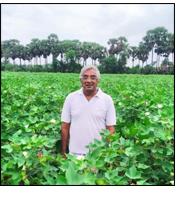 Ravichandran is a third-generation farmer from Tamil Nadu, India, with over 39 years of experience cultivating rice, cotton, and pulses. A staunch advocate of science-based, sustainable agriculture, he champions the use of technology, AI, and biotechnology to boost productivity and build climate resilience. He currently serves as Global Director of the Global Farmer Network.
His innovations in water-efficient rice farming and enhanced pulse productivity have earned him national and international recognition, including the Dean Kleckner Award and the IARI Fellow Farmer Award. As a writer, speaker, and mentor, Ravichandran empowers fellow farmers to embrace modern methods-always proud to be known by one defining word: Farmer.
ET: Can you tell us a bit about your farming journey-how it all began and what your farm looks like today?
VR: My farming journey began when I was 25 years old. I hail from a farming family in Poongulam village, Nannilam Taluk, Thiruvarur District, Tamil Nadu. I completed my schooling from 1st to 11th standard in Nannilam, where the medium of instruction was Tamil. Having a flair for mathematics, I pursued my Pre-University Course and Bachelor's degree in Mathematics. After graduating with high marks, I chose to pursue Chartered Accountancy and underwent my articleship in a reputed CA firm in Chennai.
Just after I cleared the CA Intermediate exams and was preparing for the finals, my father-who managed our family farm - was diagnosed with cancer. I had to abandon my ambition of becoming a Chartered Accountant and take over the responsibility of managing the farm.
Being born and raised in a farming family, the transition was relatively smooth. Looking back, in the mid-1980s when I entered farming, we had access to abundant high-quality groundwater at just 40 feet. Labour was adequately available. Besides a tractor, we lacked other farm machinery. I was unfamiliar with hybrid seeds, seed drills, harvest combines, GM crops, mobile phones, or advanced breeding technologies. That period followed the Green Revolution's first wave - from 1966 to 1976 - when yield levels had started to plateau after a steep rise. Even so, farming was still remunerative and attracted many young people at the time.
Today, everything has changed drastically - almost turned upside down. My farm has evolved significantly with the times. We now use improved seed varieties, drip irrigation, mechanized tools for sowing and harvesting, and digital platforms for accessing market and weather information. I practice a combination of traditional knowledge and modern science, including trials with GM crops, precision nutrient management, and sustainable pest control methods. My farm serves not only as a source of livelihood but also as a platform for experimentation, innovation, and demonstration for fellow farmers. It reflects the journey of Indian agriculture itself - from traditional to tech-driven.
ET: You are considered a Progressive Famer. What does that mean and what inspired you to move toward more sustainable and technology-driven farming practices?
VR: Thank you for categorizing me as a progressive farmer - this recognition truly inspires me.
I have always been open to science-based, innovative farming systems - be it Genetically Modified (GM) crops, water conservation technologies, or Direct Seeded Rice. From the day I entered farming, I have consistently explored alternative practices and modified existing systems to ensure they are environmentally sustainable, economically viable, and, above all, adoptable by farmers at large.
In the early years, I faced repeated setbacks due to both biotic and abiotic stresses, which often led to severe economic losses. Debt traps were not uncommon. It would typically take at least three good cropping seasons to recover. But if similar agro-catastrophes struck again, the situation would worsen. At that time, we neither had access to the technological interventions we now benefit from nor any dependable crop insurance schemes. Farming felt like a game of snakes and ladders - uncertain and risky.
This experience shaped my mindset. I began embracing hybrids, marker-assisted stress-tolerant varieties, and BT cotton-currently the only GM crop allowed in India, despite the robust scientific validation behind GM technology. I also adopted farm machinery, safe and effective crop protection chemicals, and, more recently, AI based advisory services.
I consider myself a lifelong learner. Since the beginning of my journey, I have built lasting friendships with agricultural scientists, attended numerous seminars, conferences, and farmer-scientist interactions. My association with networks like the Global Farmer Network and the World Economic Forum's Transformation Leaders has given me exposure to global best practices. The visible success of science-based, technology-driven agriculture has continuously inspired me to pursue sustainable innovations that empower not just me, but every farmer.
ET: As a board member of the Global Farmer Network, how do you see the role of Indian farmers evolving in the global agri-value chain?
VR: India's agricultural sector, while contributing approximately 14.5% to the nation's Gross Value Added (GVA) in FY25, remains the primary source of employment, engaging about 44.1% of the workforce. This underscores agriculture's pivotal role in sustaining livelihoods and ensuring food security for over 1.4 billion people.
The country's diverse agro-climatic zones - 15 major regions encompassing 72 sub-zones - enable the cultivation of a wide array of crops, positioning India as a significant contributor to global agricultural diversity, an advantage very few nations enjoy.
Despite challenges such as the predominance of small and marginal farmers, reliance on monsoon rains, and fragmented policy frameworks due to agriculture being a state subject, Indian farmers have demonstrated remarkable adaptability. The widespread adoption of BT cotton, covering nearly 95% of the cotton-growing area by 2022, exemplifies their willingness to embrace scientific advancements that enhance productivity and sustainability.
Moreover, Indian farmers are increasingly adopting climate-smart agricultural practices, such as the System of Rice Intensification (SRI) and Sustainable Wheat Intensification (SWI), which have shown significant economy-wide benefits while reducing greenhouse gas emissions and water usage. These initiatives highlight their proactive role in addressing global challenges like climate change.
Participation in the Global Farmer Network has provided me with a broader perspective on shared challenges, including climate variability, trade dynamics, and geopolitical tensions. Addressing these issues requires collaborative, science-based policy interventions that empower farmers worldwide.
In conclusion, Indian farmers are not just integral to national food security but are also vital contributors to the global agricultural value chain, offering resilience, innovation, and a commitment to sustainable practices.
ET: How can policy makers better support farmers like you who are taking a forward-looking, sustainable approach to agriculture?
VR: While all sectors are subject to regulations, agriculture often faces more stringent restrictions, particularly concerning access to trade and advanced technologies. As farmers, our responsibilities extend beyond our livelihoods; we are custodians of the nation's food security and providers of affordable, nutritious food for over 1.4 billion people.
India's vision of becoming a developed nation by 2050 ("Viksit Bharat") underscores the pivotal role of agriculture, which remains a major employment provider and a driving force of our economy. Policymakers must address existing policy bottlenecks to facilitate this transformation.
While we honour traditional agricultural wisdom, a pragmatic, science-based approach is essential for progress. Other sectors benefit from advancements in science and technology; agriculture should be no exception. Unfortunately, several scientifically validated agricultural technologies, especially in seed development, are still confined to laboratories due to delays in policy approvals, despite clearance from relevant regulatory bodies. These delays often stem from non-scientific considerations.
Without timely access to these innovations, their value remains academic, and farmers are disadvantaged in the global market, competing against counterparts who benefit from advanced technologies and larger farm sizes.
Although the majority of Indian farmers are small or marginal, collective models like Farmer Producer Organizations (FPOs) can enhance bargaining power and resource access so that we can compete with farmers from the rest of the world. However, the FPO framework requires further refinement to realize its full potential.
Policymakers should expedite the approval of pending agricultural technologies and ensure that decisions are grounded in scientific merit. As Pandit Jawaharlal Nehru aptly stated, "Everything else can wait, but not agriculture."
Furthermore, it's crucial to involve farmers-especially those offering unbiased, non-political perspectives-in the policymaking process. Agricultural policies must prioritize the national interest and the welfare of the farming community.
ET: What advice would you offer to young farmers who want to stay rooted in agriculture but also want to be part of shaping its future?
VR: I extend my heartfelt congratulations to the energetic youth aspiring to contribute meaningfully to agriculture while aligning with the vision of 'Viksit Bharat 2050'. The future of our economy - and more specifically, Indian agriculture - rests on the shoulders of next-generation farmers. Agriculture offers vast scope for innovation and nation-building.
Young farmers should embrace modern technologies, stay updated through continuous learning, and build collaborative networks. They must advocate for science-based policies and adopt sustainable practices to ensure long-term resilience. As John F. Kennedy once said, "Farmers buy in retail, sell in retail, and pay freight in both cases" - a reality that resonates deeply in the Indian context. To overcome this, young farmers should come together to form FPOs, focus on value addition, and harness their collective strength for better bargaining power and profitability.
By blending traditional wisdom with modern tools, they can shape a vibrant and sustainable future for Indian agriculture.
back to top ^
|
|

|
|
 When I finished reading this book, I had to think long and hard about how to write a review befitting the content and the author. How do I pack it all in a thousand words or thereabouts?
I'm putting my last paragraph up front here, just in case some readers may not want to go through the rest of the review. In a world where we make much of quick wins and even louder success stories, touted on every social media platform, Indomitable stands out for its quiet strength. To aspiring leaders and leaders of yore, it is a reminder that leadership is not about having all the answers, but about evolving, adapting, being agile, and staying rooted in purpose.
One line from the book that left an impression on me is: Leadership is not about perfection. It is about being persistent even when the road is uneven. It is about listening more than speaking, especially when one is at the top and making a contribution that is felt, but not hogging the credit. It is about succeeding along with others.
This sentiment underscores her acknowledgment of the imperfections inherent in leadership and the ongoing journey of striving for improvement.
That said, for those who choose to read on...
The title Indomitable is well chosen. Arundhati Bhattacharya does not portray herself as invincible. She writes of failures, doubts, and moments of exhaustion. Her use of personal anecdotes - early-career rural postings, fraught policy meetings, quiet family moments - adds emotional texture to what could have been a dry recounting of professional history. There is a calmness to her narrative, a steadiness that mirrors the leader she became. What burns through the most is her resilience, not perfection. Her version of leadership is about showing up every day, asking questions, collaborating in what is often a male-dominated space, and holding firm to core values.
Few memoirs capture the personal, institutional, and societal dimensions of leadership the way this one does. Bhattacharya writes with clarity and without corporate jargon. The tone is conversational, not self-aggrandizing. For instance, when recounting her first significant leadership challenge at the State Bank of India, she says that she was not concerned with impressing anyone, just with getting it right.
This intentional style echoes her leadership ethos - grounded, steady, and without pretence. Her story unfolds not in dramatic leaps but through steady strides: years spent in rural areas learning the intricacies of banking, making tough family decisions during transfers, and hoping they were the right ones.
Reading about her experience during the 2016 demonetization, when even heads of banks were kept in the dark, her tone remains measured. She recounts that, despite the chaos that followed, there was no panic in her mind - just a focus on how to make it work for customers. This was evidenced by the fact that SBI received more complimentary letters than complaints during demonetization. She reminded her staff that the anger of the public stemmed from fear and helplessness and it was not personal.
Such moments humanize her professional journey. They show her deep personal investment in her work, allowing the reader to walk alongside her rather than observe from a distance.
She recalls specific moments - the tension in boardrooms, the challenges of modernizing a traditional institution - to illustrate her practical, transparent approach to leadership. She explains decisions and constraints without dramatizing them. The previous reputation was not one of great collaboration and since collaboration was how she believed she could take the bank forward, she walked the talk. When discussing her challenges as SBI's head, she shares that
"I followed a few protocols invariably, and, consistently. I continued to address them as 'sir' (the common SBI appellation for a senior male colleague). I also ensured that whatever changes I made, in their area of operations, I did it in consultation with them and with their participation."
She engaged with them-not in grand speeches but in small, consistent acts of listening and action-building trust, one decision at a time.
For those in leadership, public policy, or finance, Indomitable offers valuable lessons in institutional reform. Her push for digital banking, HR reforms, and customer-centricity were not headline-grabbing victories, but slow, sometimes unpopular reforms implemented with patience and vision.
Readers looking for literary embellishment may find the style plain. But in a story about breaking glass ceilings in India's largest bank, simplicity is a strength. It lets the substance shine.
For those who stayed with me, I’ll end with that line again - slightly rephrased: True leadership isn't about perfection. It's about persistence through uneven roads, about listening more than speaking - especially when you sit at the top.
back to top ^
|
|
| |
|
THROUGH THE LENS
|

|
|
Nature photographer Rupesh Balsara sights the elusive White-rumped Shama. Known for its glossy black and chestnut plumage and long white-tipped tail, this shy songbird thrives in dense undergrowth and bamboo thickets. It feeds mainly on insects such as ants, beetles, and caterpillars, often foraging close to the ground. Though not endangered, the White-rumped Shama is protected in India due to past threats from habitat loss and trapping for the songbird trade. The White-rumped Shama, a symbol of the forest's hidden beauty, is a delight for birders and conservationists alike.
|
|
|
|
Empowered Learning Systems
www.empoweredindia.com
101, Lords Manor, 49, Sahaney Sujan Park,
Lullanagar, Pune – 411040,
Maharashtra, India


|
 The ELS Lotus logo is trademark of Empowered Learning Systems The ELS Lotus logo is trademark of Empowered Learning Systems
©2025 Copyright Empowered Learning Systems (ELS). For private
circulation to clients and well-wishers of ELS. While ELS endeavors to ensure
accuracy of information, we do not accept any responsibility for any loss or
damage to any person resulting from it.
|
|
|
|
|
|
| |