|
|
|
|
| |
Dear Reader,
In a world defined by rapid disruption, cutting-edge research is no longer a luxury - it is the foundation of India's competitiveness. From quantum computing and genomics to space exploration and green energy, our scientific ecosystem has produced breakthroughs that rival the best in the world. Yet the progress remains uneven. While pockets of excellence thrive, many research institutions continue to be constrained by fragmented funding, bureaucratic hurdles, slow commercialization pathways, and a culture that still undervalues interdisciplinary collaboration.
India's greatest opportunity lies in bridging this gap - where the spirit of inquiry meets the engine of innovation. Our scientists are not short of ambition; what they often lack are enabling structures: risk capital, high-trust partnerships with industry, and a regulatory environment that encourages experimentation rather than penalizing it. When talent is empowered, the results are extraordinary - ISRO's lunar missions, indigenous biotech innovators, AI research labs, and university-driven start-ups stand as living proof.
This issue of Empowering Times (ET) explores "Cutting-edge Research in India: Challenges and Opportunities" - a theme that invites us to rethink how we nurture innovation. The goal is not just to produce more research, but to produce impactful research: discoveries that convert into industries, livelihoods, and global influence.
In the Thinking Aloud section, Jay argues that despite internet-fuelled science scepticism rooted in fundamentalism, conspiracy, and weak communication, the real solution lies in strong science storytellers who make research accessible, separate myth from fact, and cultivate a society that values scientific progress. On the Podium, we feature Prof. Prabhat Ranjan, Chairman (Research, Innovation and International Relations) - D Y Patil Pratishthan, who argues that India's biggest barrier to becoming a global technological leader is not talent or resources, but the speed of execution, tolerance for risk, and the ability to break rigid silos between academia, industry, and government so that deep-tech innovation can flourish at scale. In the We Recommend section, Jay reviews Priyambada Jayakumar's biography, M S Swaminathan: The Man Who Fed India. The piece portrays Dr. M.S. Swaminathan as a rare, true hero whose scientific brilliance, empathy, and moral courage transformed Indian agriculture, touched lives across the world, and left an enduring humanitarian legacy far beyond the Green Revolution.
In Figures of Speech, Vikram's toon reminds us that breakthroughs take time!
Please also Click Here to check out our Special issue of ET, which is a collation of selected themes that were featured over the years highlighting the changing landscape of the business world. This special edition has been well received and can be Downloaded Here for easy reading and is a collector's item.
As always, we value your opinion, so do let us know how you liked this issue. To read our previous issues, do visit the Resources section on the website or simply Click Here. You can also follow us on Facebook, LinkedIn, X, Threads & Instagram - where you can join our community to continue the dialogue with us!
|
| Succeeding in Business: Nurturing Value in Family Business |  |
|
 |
Click below to order your copy now


Special offer for Empowering Times readers. Get 30% discount by using coupon ETSPECIAL on the Notion Press online store.
Click here to connect with Jay.
|
|
|
|

|
|
It seems odd that even in the 21st century we have a fairly large number of people who can loosely be called 'science sceptics'. But they exist and, given the power of the internet, are able to amplify their message to generate a following that is willing to question policy makers and freely indulge in fearmongering.
Be it the issue of human evolution, questions of the earth's shape (the earth is flat, some maintain), moon landing (oh, a Hollywood production), effectiveness of vaccines ('a Big Pharma charade'), or global warming ('nope, there's no such thing as climate change'), there is a whole group of doubting Thomases who are ready with a volley of questions calculated to misguide if not to totally deny empirical data. To them, it is all a CIA conspiracy funded by capitalists to exploit the innocents.
Why does this happen? The reasons are not so difficult to find. First, there is always a category of fundamentalists who are so bound to their literal religious texts that they are not open to rational ideas which in their minds violate the word of God. Then there are the cantankerous who love pointless debates with their posturing. In this context it would be wise to remember the old saying that 'Never argue with an idiot, they will drag you down to their level and beat you with experience'. A third category belongs to the conspiracy theorists who perpetually smell a rat when there is none. To them all mysteries of the universe are but an alien plot to enslave mankind!
The group that can be salvaged are those with curious minds who have genuine questions that deserve an answer. Engaging with them can sometimes be beneficial as it can open new avenues for investigation. Plus, the added benefit that it enables one to sharpen one’s own logic while clarifying ideas. Indeed, this is a large community who are waiting to learn once explanations are offered in a reasonable manner with the added 'aha!' of WIIFM (what's-in-it-for-me).
However, perhaps a major reason for this gap in the public’s understanding of the value of scientific endeavor lies with scientists. So absorbed are they in their probing discoveries in an obstruse world of research that they have failed to communicate with the real world where laymen live in splendid mediocrity. It is important to realize that most people across the globe are either struggling to tackle their daily challenges or are caught in their self-indulgent practices to value intellectual enquires. Expecting them to grasp esoteric ideas is tantamount to deliberately creating complexities from which they have always sought escape.
What is needed therefore is a group of science communicators who have the intellectual bandwidth for comprehending scientific models, adept at simplifying jargons for consumption in everyday language, with an amiable disposition and skillful in weaving a storyline to perk up the most hard-boiled disbeliever. Think Carl Sagan, David Attenborough, Neil deGrasse Tyson, or our very own Jayant Narlikar (though arguably he was a touch too serious). In today’s world where readers have been replaced by viewers (or voyeurs), a visual commentator scores over a prolific writer. Regrettably this is a scarce talent. Nevertheless, it is this group that can describe the power and impact of science and dispel misgivings from the minds of the innocent, the uninformed, and the immature.
With the rising tide of nationalistic spirit of a post-Macaulay India, perhaps we need to find these exceptional raconteurs who can tell us our own history of scientific researchers. It is useful to bring alive the story of early pioneers be it J C Bose, C V Raman, Subrahmanyan Chandrasekhar, Homi Bhabha, Vikram Sarabhai, Satish Dhawan, Abdul Kalam, M S Swaminathan, etc. Indeed, it is useful to hark back into India’s ancient scientific traditions too and bring alive the work of Aryabhata, Sushruta, Charaka, Brahmagupta, and many others whose work is now being acknowledged across the world. A good chronicler can also differentiate superstition from fact – and can put to rest mythology from authenticity. It is not true that there was no understanding of the physical world before the western world wrote about it but a blind belief that all was rosy in ancient times is a chimera that belongs to WhatsApp University.
It is time to build a community that appreciates that it is scientists who shape society by giving us tools that enable us to think critically, and generate a better life because they invent beneficial products that provide comfort and protection in our physical world.
back to top ^
|
|
|
|
 Prof. Prabhat Ranjan currently serves as the Chairman (Research, Innovation, and International Relations) for Dr. D Y Patil Pratishthan. He is also the former and founding Vice-Chancellor of D Y Patil International University (DYPIU), Pune, an institution he led to national prominence by setting new educational benchmarks.
A distinguished expert across multiple domains, Prof. Ranjan is recognized as a nuclear fusion scientist, futurist, educator, innovator, and science communicator.
From 2013 to 2018, he held the position of Executive Director at TIFAC, India's technology think tank, in Delhi. During his leadership, TIFAC successfully developed the foundational "Technology Vision 2035," which was officially released by the Hon'ble Prime Minister in January 2016.
His scientific career boasts nearly two decades of significant contributions to nuclear fusion research, conducted in both national and international laboratories across India and the USA until 2002. More recently, he co-founded ASPL Fusion to pioneer the application of nuclear fusion technologies across multiple domains.
Prof. Ranjan's innovative impact is broad, encompassing contributions to India's Moon Mission – specifically his involvement in Chandrayaan-II from 2007 and ongoing work in planetary exploration – as well as the Wildlife and Agriculture sectors. He is particularly acclaimed for his transformative innovations in assistive technology, which have profoundly improved the lives of persons with severe disabilities.
He also represents India in international Brain-Computer Interface standardization processes.
Prior to his leadership roles, he served as a Professor at the Dhirubhai Ambani Institute of Information and Communication Technology (DA-IICT) in Gandhinagar for 11 years.
Academically, he holds a PhD from the University of California, Berkeley, and completed his undergraduate studies at IIT Kharagpur and the University of Delhi, following his schooling at the Gurukul-style Netarhat School.
Additionally, Prof. Ranjan chairs the AICTE IDEALab NARC, a highly successful initiative by the All India Council for Technical Education.
ET: In your experience, what are the key structural or systemic challenges - scientific, technical, or managerial - that India must address to compete globally?
PR: The biggest challenge is not money or talent - it is speed of execution and tolerance for risk.
We still treat research projects like civil works contracts: endless tenders, lowest-bidder wins, fear of CVC/CAG, three-year funding cycles, and zero tolerance for honest failure. Many major projects of critical importance to the country get delayed by years due to procedural issues. The same disease exists everywhere.
Second, till recently we had almost zero patient capital for deep-tech. Industry wants returns in 18–36 months, VCs want 100× in five years. No one funds the 10–15-year valley of death that quantum, fusion, new materials, or advanced biotechnology require. This may change with the announcement of the ₹1 trillion RDI fund by the government.
Third, the walls between academia, industry, and government are made of reinforced concrete. Professors are rewarded for papers, not patents or products. Industry treats universities as cheap labour pools, not equal partners. Government writes beautiful policies but it is rarely implemented at the speed required. Faculty should be allowed to take up to 3 years entrepreneurship leave.
Fourth, we still suffer from "import mind-set" in critical equipment and components. Even when Indian alternatives exist (or can be developed in 12–18 months), purchase committees prefer foreign quotes because "foreign = safe".
Until we fix our risk appetite, funding horizons, and the trust deficit and lack of mutual respect between these three pillars, we will keep producing papers and PhDs but very few global technology leaders.
ET: Which emerging fields - such as quantum tech, AI, biotechnology, or space sciences - do you believe hold the greatest potential for India in the next decade?
PR: In the next 10–15 years, three fields will define winners and losers:
- Artificial Intelligence + Robotics + Synthetic Biology combination (what I call the "new industrial revolution"),
- Quantum technologies (computing, sensing, communication), and
- Controlled Nuclear Fusion.
AI is already happening at scale because the entry barriers are low and private capital is flowing. Quantum is where India can actually leapfrog - we have extraordinary mathematical talent, relatively low-cost cryogenic and laser infrastructure building capability (from space and fusion programmes), and the National Quantum Mission is finally moving. If we execute ruthlessly, India can be among the top three nations with useful quantum advantage by 2035–40. I was pleasantly surprised to see a diamond manufacturer in Surat working on Nitrogen Vacancy Center in Diamond for quantum technology.
But the dark horse that will matter most to India is nuclear fusion. By 2035–40 the first generation of commercial fusion reactors will start coming online globally. If India is not ready with its own reactor-level technology and supply chain by then, we will again become importers of the ultimate clean energy technology, just as we did with nuclear fission. Fusion is the only energy source that can give India true energy independence while meeting net-zero goals. In addition to power production, nuclear fusion can also be used for many applications including fusion-fission hybrid technology. The day we master it, our per-capita energy consumption can rise 5–6 times without guilt. Considering this, I have co-founded a company called "ASPL Fusion". Our initial focus is on producing medical radioisotopes for cancer diagnostics and therapy.
ET: How can India strengthen collaboration between academia, industry, and government to accelerate breakthrough research?
PR: Stop treating them as three separate entities and create overlapping ecosystems.
What actually works (I have seen it work):
- Industry funds 30–50 chaired professors in universities with full freedom to publish and patent.
- Every major R&D programme (quantum mission, fusion, semiconductors, and batteries) must mandate 30–40 % budget to universities and start-ups, not just to PSUs and national labs.
- Create "Mission Innovation Campuses" - 500–1,000-acre campuses where DRDO/ISRO/DAE labs, IITs/IISERs, and large companies and start-ups share the same campus, same canteen, same playground. Physical proximity beats MoUs.
- Allow faculty to hold equity in spin-offs and spend up to 50 % time in industry without losing lien (Singapore model). Joint faculty appointments between industry/research labs and University should be permitted.
- Create a ₹10,000 crore "First-of-its-kind Engineering Fund" that funds Indian companies/universities to build critical equipment indigenously even at 2–3× imported cost for the first few units (exactly what China did).
ET: You have been a pioneer in Nuclear Fusion research in India. Please elaborate as to why this is important for India's development.
PR: India's current installed capacity is ~450 GW (2025). To reach developed-nation status by 2047 we need at least 2,500–3,000 GW. Renewables alone cannot provide 24×7 baseload at that scale without massive land and storage challenges.
Fusion offers:
- Virtually unlimited fuel (deuterium from seawater, tritium bred in blanket)
- No long-lived radioactive waste
- No meltdown-proof
- Energy density millions of times higher than chemical fuels
If we master fusion, India can become an energy exporter instead of spending $200–300 billion annually on energy imports. More importantly, cheap, clean, abundant energy is the ultimate poverty-eradication tool - it powers desalination, hydrogen production, data centres, AI training, electric transport, everything.
We have seen Tokamaks produce plasma 12 times hotter than the sun's core. The physics works. Now only engineering and materials remain. The countries that solve the remaining problems will rule the 21st–22nd centuries. India cannot afford to be a buyer in that market.
ET: What is your vision for India as a global research powerhouse by 2040, and what steps do we need to take today to get there?
PR: By 2040 India should be among the top three nations in scientific publications, patents filed, deep-tech unicorns, and Nobel prizes in science, and - most importantly - technologies that actually improve the lives of the bottom three billion people on the planet.
That means:
- R&D spend at 3 % of GDP (from current ~0.7 %) with at least 50 % from private sector.
- 30 Indian universities in global top 200 (we have three today).
- At least 1000 deep-tech start-ups (not just apps).
- India as the preferred destination for global talent (reverse brain drain + attract foreign researchers).
Steps we must take today (2025–30 window is critical):
- Create a ₹1 lakh crore "National Deep-Tech Mission Fund" with 15-year horizon, governed by scientists and entrepreneurs, not bureaucrats. (Govt has done this through RDI Fund!)
- Pass a "Scientific Freedom Act" that protects researchers from audits for honest failure and allows flexible spending.
- Make every IIT/IISc/IISER adopt 100 nearby colleges as mentors and share faculty, labs, and PhD students.
- Mandate that every company above ₹5,000 crore turnover must spend 1 % of profit on university research or pay it as cess.
- Create ten "Global Challenge Campuses" (like Bell Labs + MIT Media Lab + Fraunhofer) focused on fusion, quantum, climate tech, neuroscience, etc., with full autonomy.
I have spent my life building pieces of this - from Tokamaks to AICTE IDEA Labs to Technology Vision 2035. The blueprint exists. What is missing is only the national will to execute at wartime speed.
We have the people. We have the need.
Now we need the courage to act like a civilisation that once again wants to lead the world.
back to top ^
|
|

|
|
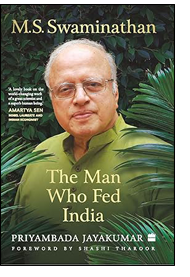
The word 'Hero' is overused in today's world. In the classics he is the main protagonist, admired by all for his nobility, courage, and extraordinary strength. More importantly, the 'Hero' is one who uses these personal characteristics to take on challenges and deliver great benefits to those in need. Such is the aura of the 'Hero' that he is remembered with awe by those who come into contact with him, and he is immortalized by tales of his valor and generosity. Given the high standards needed to qualify for the heroic mantle that few truly merit it, the 'Hero' is often a fictitious person seen in story books or the movies.
However, a few personalities have actually qualified for this unique honor, and Dr. M S Swaminathan is one of these rare individuals. To know why he received universal acclaim and is celebrated as the Father of the Green Revolution in India, turn to Priyambada Jayakumar's biography, M S Swaminathan: The Man Who Fed India.
The book presents the life of a man who impacted not just India's agriculture but also strode the global arena and offered his wisdom and soft touch to win over dictators, democrats and laymen. A brilliant scholar who grew up in rural Tamil Nadu, he easily qualified for the highest echelons whenever he tried but never lost touch with the ground realities he had seen – and felt close to – wherever he went. His transformational work in India has been celebrated for decades. The book offers more, devoting a chapter to lesser-known events from his stint as the Director General of the International Rice Research Institute (IRRI), Manila, where he won hearts as 'Tatay' (Father in Tagalog) during a turbulent political period in Philippines. Of course, much credit is also due to his wife, Mina, who was a stalwart in her own right, and an equal partner in many of Dr. Swaminathan's social endeavors, including the M S Swaminathan Research Foundation. The book particularly highlights that it was Mina Swaminathan who was crucial in enabling her husband to integrate closely with the Filipino society as she took the initiative to learn Tagalog and delivered a flawless speech at the farewell function when they left Manila. Together they made a deep impact in Philippines and won the affection of the local people.
One could say that this was the trademark of the leader that Dr. Swaminathan truly was. He was beloved to many not for his intellectual acumen alone (as one would expect in a scientist of his caliber), but it was his empathy for the conditions of the people who were impacted by his work, and the team that he worked with that made him an outstanding human being. Irrespective of rank, social condition, or economic status, he accepted everyone without hesitation and in turn was acceptable to all. One such telling story the book narrates is of Pakkirichi, a Dalit lady who had been barred from entry into a temple in Pondicherry during a farmers' mobilization event. It took a courageous stance from Dr. Swaminathan to demolish the die-hard resistance of the village council to her entry breaking established taboos – but that was the nature of this principled man.
Questioning conventional wisdom and choosing untrodden paths was a choice that Dr. Swaminathan made from his early days. His parents set a sterling example to him, as the author recounts, and Dr. Swaminathan chose to be inspired further by the Mahatma and the bard of India, Tagore. Ekla Chalo was not just a poem for him but a philosophy that he lived by, and this made him the herald of change. The author relates many episodes from the doyen's life where his gentle words and amiable manner won over the harshest critics, apart from bringing more admirers into his fold. Rational thought from first principles and a persuasive and persistent pitch were his magic wands through which he generated supporters at all levels.
While the Green Revolution is a watershed in human existence, few may know the challenges that had to be overcome to begin the journey. The book does remarkably well to take us behind the headlines and gives us the story of what it took to convince politicians, economists, scientists and farmers, decision makers and opinion architects all, to attempt field experiments at a time when pessimism was at its height and despair the emotional response. The horror of PL480 has been forgotten in today's India which is flush with food grain, but it took men like Dr. Swaminathan to lead us from the days of despondency to a world of surplus because they had seen the darkest days of the Bengal famine and the arm-twisting by foreign powers, and promised themselves that they would not allow this to ever happen again. 'Calamities should be the instigators of progress', was the watchword for the optimist in him. It was not just patriotic fervor, the author stresses; it was the humanity in the man, which came from the realization that, 'If agriculture goes wrong, nothing else will have a chance to go right', as he is often quoted.
The quest, therefore, was for an evergreen revolution, one that would sustain productivity, as Dr. Swaminathan realized that misuse and misapplication of science also would create new hurdles to farming. Foreseeing the climate crisis, he exhorted policy makers not to neglect mangroves and spoke about the role of rain forests everywhere. As a believer in holistic solutions, Dr. Swaminathan looked at the larger picture and was willing to contest shibboleths about the rural sector. He understood that the female farmer was a story of neglected reality, and he championed their cause as never before. Sadly, the private members' bill that he introduced in the Rajya Sabha - Women Farmers' Entitlements Bill 2011 – failed to gather support due to the political machinations of the country, but there has been no louder voice than his for championing the cause of the under-appreciated gender of the agricultural sector.
One could go on about the legend and his achievements, culminating with the ultimate posthumous recognition, the Bharat Ratna. I am sure the author must have been tempted to do so. As the niece of this giant, the author had unparalleled access to his life and work, and when quizzed about her decision to write the book, emphasized that Dr. Swaminathan's gigantic legacy must be viewed beyond the agricultural lens & that she wanted to present the larger and more correct portrait. Here was a colossus who was more than a humanist, wearing many hats with rare aplomb, yet never losing the common touch, and welcomed across the globe as one of their own. The author has painstakingly made it her cross to the tell this story to the world of today which has fleeting memory and even poorer respect of great men. I am glad that she has presented this magnificent picture of a man of multiple talents, and how he has transformed our world, with his kind touch.
Definitely a book that needs to be read widely to keep the flame burning bright.
back to top ^
|
|
| |
|
THROUGH THE LENS
|
|
|
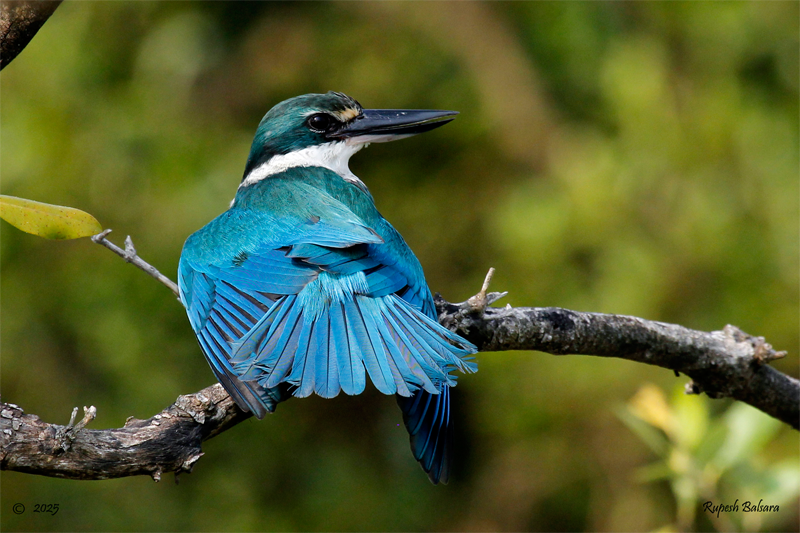
Nature photographer Rupesh Balsara recently spotted the White-throated Kingfisher - a mid-sized kingfisher commonly found across India, thriving in diverse habitats such as wetlands, agricultural fields, urban gardens, and forest edges. It feeds primarily on fish, but also hunts insects, small reptiles, amphibians, and even small birds - making it one of the most versatile predators in its family. The species is not endangered and is currently classified as Least Concern by the IUCN, thanks to its wide distribution and strong adaptability to human-modified environments.
|
|
|
|
Empowered Learning Systems
www.empoweredindia.com
101, Lords Manor, 49, Sahaney Sujan Park,
Lullanagar, Pune – 411040,
Maharashtra, India


|
 The ELS Lotus logo is trademark of Empowered Learning Systems The ELS Lotus logo is trademark of Empowered Learning Systems
©2025 Copyright Empowered Learning Systems (ELS). For private
circulation to clients and well-wishers of ELS. While ELS endeavors to ensure
accuracy of information, we do not accept any responsibility for any loss or
damage to any person resulting from it.
|
|
|
|
|
|
| |