|
|
|
|
| |
|
Dear Reader,
Every publication has its own rhythm - shaped by the times it inhabits, the questions it dares to ask, and the conversations it nurtures along the way. For Empowering Times, the journey has always been about pausing amid change to reflect, to question assumptions, and to explore how business, leadership, and society evolve together. As this e-zine reaches its final issue, it feels only appropriate to do what we have always done best: look thoughtfully ahead, even as we take stock of the road travelled.
This issue's final theme, Future Tense: Five Transformations that Business will Create to Impact Society in the Next Decade, looks ahead with intent. It invites readers to reflect on how emerging technologies, shifting consumption patterns, sustainability imperatives, and new models of value creation will redefine not just markets, but the very fabric of society. It is a fitting theme on which to close-forward- looking, provocative, and anchored in responsibility.
In the Thinking Aloud section, Jay reflects on the arc of time and transformation - reminding us that while organizations strive for permanence, change remains the only constant. From the illusion of arrival at the summit of success to the disruptive force of Artificial Intelligence now reshaping business longevity, his essay urges leaders to remain vigilant, adaptive, and deeply human in their choices. Progress, as he notes, is neither linear nor guaranteed; it is earned repeatedly through courage, restraint, and thoughtful execution.
On the Podium, Prof. Jagdish N. Sheth brings the journey full circle. The very first issue of Empowering Times opened with his reflections on human capital and organizational potential, and it is fitting that this final issue concludes with his views on the future shaped by Artificial Intelligence. Drawing from decades of scholarship and observation, he frames AI as an invisible yet pervasive force - much like air - reshaping education, enterprise, consumption, and social interaction. While he does not shy away from the risks, his enduring faith in human adaptability, resilience, and the capacity to learn offers a reassuring counterpoint to the more dystopian narratives that dominate public discourse.
In We Recommend, Jay reviews The Thinking Machine by Stephen Witt, a compelling account of Jensen Huang and the rise of NVIDIA - arguably one of the most consequential companies of our time. The review situates Huang alongside the pantheon of transformational innovators while probing the deeper question that confronts us all: are we witnessing a durable inflection point in human progress, or the early tremors of an overheated technological moment? The answer, as always, lies in how wisely we choose to deploy the tools we have created.
In Figures of Speech, Vikram's toon captures progress powered by collaboration!
For readers who wish to revisit milestones along this journey, please Click Here to explore our Special Issue of Empowering Times - a curated collection of themes featured over the years, highlighting the evolving business landscape. This edition has been well received and can be Downloaded Here for easy reading; it is truly a collector's item.
This journey would not have been possible without the contributors who trusted us with their insights, the editorial team that stood committed to quality and timeliness, and Jay, whose intellectual rigour and thematic clarity anchored the publication through its many phases. Most importantly, I remain grateful to our readers - those who read closely, wrote back, questioned, and stayed with us through the years.
As this final e-zine finds its way to you, I see it not as an ending, but as a pause in a longer continuum of learning and exchange. Ideas do not retire; they migrate, resurface, and find new platforms. I hope the spirit of Empowering Times - thoughtful, questioning, and grounded - continues to travel with you into whatever you read, build, or reflect upon next.
As we close this chapter, we wish you Happy Holidays, renewed hope, and courage for the road ahead. May the New Year 2026 bring clarity, compassion, and thoughtful progress in equal measure.
Thank you for allowing me the privilege of being your Editor.
- Melinda Rodrigues
|
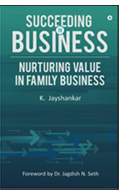
Out Now!
Succeeding in Business: Nurturing Value in Family Business
Click below to order your copy now


|
|
Special offer for Empowering Times readers. Get 30% discount by using coupon ETSPECIAL on the Notion Press online store.
Click here to connect with Jay.
|
|
|

|
|
Fifteen years ago, the first issue of Empowering Times reached your hands. It featured Dr. Jagdish Sheth on the Podium, where he stressed that organizations should view Human Capital holistically. He added that, 'The internal structure or the culture, or say the bureaucracy of organizations, plateaus the potential of the individual in an organization,' and cautioned against taking a narrow view of the talent within. Allowing ample expression to teams and empowering individuals is the mantra which has often been recommended - but doing this in practice has always been challenging.
In a world where brands matter, magazines love to pin stickers on companies and anoint them as admired firms and wonderful work organizations. While debating on the merits of the award is fair game (after all, we know that people campaign hard for Nobel prizes and Oscars), stickers and markers do not ensure sustainable performance and longevity in business. The churn in Fortune's Top 10 list over the last decade - with no firm remaining in the Fortune Global 500 Top 10 every year - is ample proof that the tempo has relentlessly increased and maintaining standards is an immense daily challenge. Take the fall from grace of Indigo - an airline brand destroyed by a combination of factors, and now roundly condemned for its arrogance! Indeed, reaching the pinnacle is difficult...but never believe you have arrived.
The business longevity test threatens to become even greater with the emergence of Artificial Intelligence. To some it is a runaway train to nowhere...and for some others, they have not noticed the change, basking in the benefits that comfortable middle-class life offers. Few realize that if life is becoming easy, and commercial transactions are becoming smoother, somewhere in the background there is a technological thingamajig that is lubricating everything. At present it is not a widget but code that has been used to optimize every operation - be it production, supply chain, logistics, transportation, payments, etc. Efficiencies are generated with software that has been created by a team of backroom experts who have specialized algorithms for creating process optimization and productivity at every step in the business chain.
But these wizards too are under scrutiny now. Such has been their excellent work that a new category of intelligence has been spawned. Having already demonstrated its potential of creative disruption, it lurks in the background as a genie awaiting our command. The 'good genie' can be a transformative partner who can take mankind to the next orbit of its evolution: humanoid robots can be programmed to be the tireless assistant that every household has sought for ages, it can be the super-efficient database that will ensure quick and efficient surgery, it can be the personal instructor to every student, and a million other myriad things. The 'bad genie' is every science fiction writer's ultimate nightmare: an energy that can hasten the destruction of mankind, and maybe even enslave us? Who knows.
Be that as it may, the future will unfold - depending on the choices made by the current generation. The wisdom to make the right call lies not just on the political leaders of the day but also on the rest of us who make decisions on a daily basis. While the pessimists tend to view human beings as easy victims to base pandering from commercial and parochial sources, the course of history illustrates that while there have been episodes of frenzied bloodletting, over time rational minds have prevailed over emotional eruptions. The pessimist may still insist that past performance does not guarantee future actions, there is more to human innovativeness and behavior than mindless self-annihilation.
I believe that exciting times lie ahead of us. New vistas await us, with multitude of novelties, crafted by brilliant minds that will be sharper than the generations that have preceded them. The evolutionary process will enable us to be more respectful of nature's bounties because we will learn how to co-exist with caution and respect for the environment that has nurtured us and enabled us to go further.
And, so the wheel turns...Empowering Times will not be there to chronicle this new emerging world. The December 2025 issue that you are now reading will be the final chapter in our journey. In the January 2010 issue, our first one, we promised you nuggets of knowledge as our contribution to trigger thoughts in your mind. Bringing the curtain down does not mean that the endeavor will cease. At the heart of the evolutionary process is new creation - and I am confident that more competent individuals, armed with AI tools, will enrich you intellectually better than before.
Namaste...Au revoir...Adios...Auf Wiedersehen...M'a Salaama...Dasvidaniya...Zaijian, Sayonara, Goodbye!
back to top ^
|
|

|
|
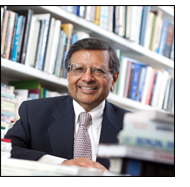 Prof. Jagdish N. Sheth is the Charles H. Kellstadt Professor of Business at Emory University's Goizueta Business School, with more than six decades of combined teaching and research experience at the University of Southern California, University of Illinois at Urbana-Champaign, Columbia University, MIT, and Emory. A globally respected strategic thinker, he has authored or co-authored over 300 papers and numerous books, including the influential autobiography The Accidental Scholar (2014) and his latest work India's Road to Transformation: Why Leadership Matters (2024).
He is a recipient of the Padma Bhushan (2020) for literature and education and holds honorary doctorates from the University of Illinois at Urbana-Champaign (2016) and Shiv Nadar University (2017), as well as all four top awards given by the American Marketing Association. Prof. Sheth is a Fellow of the Academy of International Business, Association of Consumer Research, American Psychological Association, American Marketing Association, Academy of Marketing Science (Distinguished Fellow), and the International Engineering Consortium.
A pioneering institution builder, he founded the Center for Telecommunications Management at USC, which has since become an Institute, and serves as Founder and Chairman of the India, China, and America (ICA) Institute, which analyzes trilateral dynamics in geopolitics, security, trade, and investment. He also established the Academy of Indian Marketing and the Sheth Leadership Academy to support scholarship and leadership development in marketing and management.
Together with his wife, Madhu Sheth, he leads the Sheth Family Foundation and the Madhuri and Jagdish Sheth Foundation, which support charities in India and the United States and fund scholars and scholarship globally. Through the Sheth Foundation, they sponsor the AMA-Sheth Foundation Doctoral Consortium and research in emerging fields via AMA, ACR, AMS, and AIB, and their long-standing association has led to IFIM Business School being renamed the Jagdish Sheth School of Management (JAGSOM).
ET: How do you envision AI shaping industries and societies over the next decade?
JS: AI is almost becoming like breathing air. It's everywhere. You see the impact of AI right now in enterprise markets, governments, and education. It will be in daily life too. People will get used to chatbots to guide them, making life more productive. Think about the pre-smartphone days - how hard it was to connect. Smartphones revolutionized that, and e-commerce did the same in countries like India. AI will become daily routine. Like all tech, it will have side effects and misuse, just like the industrial revolution. But the cycle of AI is faster - it will diffuse widely and quickly across sectors. And then quantum computing will follow, and that will be incredible.
ET: Do you see concerns with the emergence of AI similar to those seen with any new technology? What kind of ill effects exist?
JS: There are three concerns. First, white-collar crimes will rise immensely with AI - it democratizes crime. Cybercrimes will become more clever and increase far beyond today. Second, people will create digital clones or avatars - think about digital identity multiplying. That changes power and ways of managing others remotely, even conflict, without physical destruction. Third, AI will make life more individualized and personalized. In education, we move from the classic 3-Rs (reading, writing, and arithmetic) to 3-Is (interactive, integrated, and individualized learning).
ET - a: How will AI change the nature of education and learning beyond traditional methods?
JS: Generative AIs like Google Gemini, Microsoft Copilot, ChatGPT make computing interactive - you prompt and it responds. Education in schools, universities, or personal learning is becoming highly interactive. Old brain region distinctions are breaking. We have always been told about the left-brain and right brain - but math and music both have language structures. AI integrates knowledge fields and education becomes cumulative and yet can be individualized to meet personal needs. Consider a platform like YouTube - it is the biggest learning platform globally, and through it people everywhere can constantly learn and upgrade themselves infinitely.
ET - b: How is AI impacting family life and social interaction patterns?
JS: Yes. Families live like roommates now. My generation ate meals together and chatted. Now, eating together is a chore. Everyone finishes fast and retreats to separate devices - YouTube, WhatsApp, TV. Even food is individualized: 'This is my food in the fridge, don't touch it.' Time is scarcer than money, causing stress especially in metropolitan India.
ET: What are the most promising opportunities for AI-led innovation in India, especially given the relatively low per capita income?
JS: We often measure in US Dollars, but Purchasing Power Parity (PPP) is better for India with 1.4 billion people. India is moving from low to middle income, pushed by technology like GST paid on mobiles, and universal payment platforms - UPI is a powerful platform for every person. Leadership alignment supports economic missions rooted in cultural heritage. Modernization spans roads, energy, housing, kitchens, and toilets. Even food, shelter, clothing - all becoming modern. Over 60% of products are unbranded, but e-commerce is compressing middlemen from nine to two to three, improving accountability and margins.
ET - a: How are consumption patterns and household management evolving in India with modernization and AI?
JS: We now see branded wheat flour, packaged vegetables, etc. Young people often lack traditional skills, eating out or ordering food. Household management is changing with more organized retail and e-commerce. The whole food ecosystem is contemporary and dynamic.
ET: Can AI help us achieve inclusive growth focused on sustainability? Or will it accelerate environmental damage?
JS: Damage is hastened because sustainability and environmental issues are borderless - they are global. Pollution in one city affects others. But solutions are local. Municipalities, villages, and communities must act on water, air, and waste management. Some sites like Schiphol Airport in Amsterdam recycle everything onsite, creating self-sustaining ecosystems. India's biggest sustainability challenge is municipal governance. We must combine laws, incentives, and communities to nurture nature.
ET - a: What lessons from the Industrial Revolution apply to sustainability now?
JS: Historically, the industrial revolution's biggest mistake was treating nature like inorganic resources and overexploiting it. Production and consumption became disconnected, increasing carbon footprints from storage and transport. Today, AI can help bring production and consumption closer in time and space, enabling regenerative practices that take days instead of months. Sustainability is a global problem with local solutions.
ET: You have always been an optimist. What gives you hope for the future?
JS: My hope comes from human versatility, resiliency, and adaptability - Darwinian adaptation, not superiority. The COVID-19 pandemic showed how people adapted creatively in the face of massive disruptions. India's progress with smartphones in the last 15 years is remarkable - new capabilities unlocked for millions. Human nature has the instinct to survive and grow. When nurtured properly, human potential is infinite. Value added by polishing a human being is unlimited compared to agricultural or industrial commodities. That's the fundamental reason for hope.
back to top ^
|
|

|
|
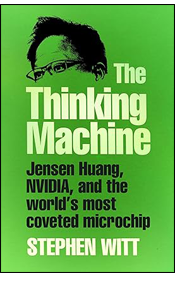
In the long tradition of American geniuses who have transformed the world, the latest is undoubtedly Jensen (originally Jen-hsen) Huang. He is the man of the moment as the world is in awe of the power of Artificial Intelligence (AI), which his firm, Nvidia, has fueled. When its market cap crossed USD 5 trillion in October 2025, it had reached stratospheric heights, unseen before by any firm. That's a humongous number - exceeded only by the GDP of two nations, the United States and China. In 5 years, its stock has risen by over 1340%. I could reel out more numbers to stun you, but the underlying question is how did this happen? And is this a bubble waiting to explode and take down the global economy with it?
Well, to get the answer to the second question, I turned to - what else? - AI! Here's what Perplexity told me: 'No, NVIDIA is not a bubble poised to explode and drag down the global economy. Its massive valuation reflects strong AI demand, with recent earnings showing 62% revenue growth to $57 billion in Q3 fiscal 2026 and projections of $65 billion for Q4, driven by sold-out GPUs. While risks like customer concentration (90% data center revenue) and high P/E ratio around 43 exist, fundamentals indicate sustained growth rather than imminent collapse.'
Let's take this statement with a pinch of salt, after all AI has a stake in perpetuating itself, isn't it? Or is it?
To get answers to these questions turn to a very interesting and engrossing read, 'The Thinking Machine', by Stephen Witt. With a reporter's ability to go behind a story, and not make it pedantic, Witt's work lifts the curtain to reveal the tale of an unlikely genius, super-possessed in taking mankind to its next stage in the evolutionary chain.
With shades of Gates, Jobs, and Musk, Jensen has all their brilliance, and their obsessive characteristics, but still shows his underlying compassion. With Jobs' passing, and the departure of Gates from Microsoft, we now live in the era of two transformational geniuses who are reshaping the world. Unlike Musk, Jensen is not known to whimsically sack employees - and welcomes them back to his firm - but boy, does he yell at them! Witt relates a lot of stories about the public whiplash that Jensen delivers to his team - and also narrates how he was at the receiving end during his last interview for the book with the mastermind. Interestingly, according to the author, this Darth Vader mode has only led to greater admiration for Jensen within the ranks of his firm, as there is unalloyed admiration for his futuristic vision, tireless working hours, obsessive quality focus, and of course, for the fact that his people have made unimagined wealth.
The book begins with the story of a young immigrant child in America. Born in Taiwan but raised initially in Thailand, his family sent him to the United States for they saw a better future for his brother and him. Bullied in school in rural Kentucky for being different, this frail, small boy had within him a steely determination and a highly competitive spirit that enabled him to overcome all barriers in his path. An engineering education was followed by a job at AMD and later at LSI Logic, and thus began his career in the chip industry. Nvidia began at the home of his co-Founder, Curtis Priem, where Jensen and Chris Malachowsky began their journey in 1993, as chip designers for the gaming industry. From there to the world of Graphics Processing Unites (GPUs) is a fascinating tale, and suffice it to say, that it is still unfolding.
A niche player who has gone on to humble the legendary Intel, and who is now re-writing all the rules of the world as they supply the GPUs on which all firms run their AI-connected activity (be it business, research, meteorology, government, tec.), Nvidia is truly the envy as envisaged by the founders when they selected their name (it was Priem's choice). The book narrates an event when Larry Ellison and Elon Musk met Jensen for dinner to convince ('beg' was Ellison's word) to allocate more GPUs for their firm - there is insatiable demand (and a black market for these magical chips) and supply cannot cope with it. Jensen has built a strong partnership with the Taiwanese firm, Taiwan Semiconductor Manufacturing Company (TSMC), for manufacturing them, thanks to his ironclad relationship with Morris Chang, the inscrutable and demanding former Chairman of the globe's best semiconductor maker. This has enabled him to even convince Chang to build a factory in the United States given the global security concern about China's encirclement of Taiwan.
The book presents the contrasting features of Jensen Huang very well: the restless and paranoid entrepreneur who devours business books and learned to admire Clayton Christiansen's work on disruptive innovation (and continues to look over his shoulder so that Nvidia is not overtaken by the next disruptor), who used to enjoy cooking meals for friends and family over the weekends, and who admits that it was his wife, Lori (also a brilliant engineer) who did 90% of the parenting, and now, at 63, working at a frenetic pace (in tune with his principle of total immersion) with barely any sleeps as he wants to be the provider of futuristic chips that will transform the world forever. To Jensen this is O.I.A.L.O. - a once in a lifetime opportunity - and he will not miss it, come what may.
The book is not about just about Jensen's life, as the Nvidia tale is intertwined with the rise of gaming, parallel computing, neural networks, multiple generation of AI development and about the many players in this arena. Indeed, the Nvidia story is incomplete without providing the context of how its growth has led to the creation and changes in all these domains. Just as Jobs did not create the cellphone but his innovation called the iPhone has changed the smartphone (and human behavior) once and for all, similarly if we are living today in the runaway world of AI, it is thanks to the GPUs that Nvidia has invented, marketed and made more powerful with every new generation that it has launched. And, just as much as hungry consumers still line up overnight to buy the next version of the iPhone every year, so also do voracious B2B customers (read businesses, countries, research institutions, etc.) who woo Jensen in the hope of jumping the queue for the next version of the magical chips from the firm. Kudos to the author for telling this parallel tale while sticking to the main plot focused on Jensen, the man who has seen tomorrow.
The book also devotes space on the 'Big Fear' that is portended by malevolent AI created by the low-cost supercomputer created with Nvidia's chips. Even Geoffrey Hinton (the Godfather of AI in popular notion and Ilya Sutskever (former Chief Scientist of OpenAI), the brilliant brains behind the theory of back propagation, neural networks, Deep Learning and OpenAI, are running scared about AI being akin to the next nuclear bomb that could destroy mankind. Will it, won't it? The debate continues - while the machine that has reduced the cost of mathematics to zero, continues its astounding charge into the future.
The frail but gutsy small boy from Taiwan has changed the world and today spins deals with Donald Trump and China. Read this book and get a picture of how he is impacting our world every day, thanks to the genie called AI that he has released with the support of his friends everywhere, from OpenAI, Microsoft, Musk, Ellison, Amazon...and many more. Thanks to Jensen - and the Nvidia team - the world is not the same anymore.
back to top ^
|
|
| |
|
THROUGH THE LENS
|

|
|
Nature photographer Rupesh Balsara recently spotted the Common Hoopoe in India, a striking bird easily recognized by its cinnamon plumage and distinctive fan-shaped crest. Found across open countryside, farmlands, grasslands, and lightly wooded areas, it feeds mainly on insects such as beetles, ants, and larvae, which it probes from the soil with its long, curved bill. The Common Hoopoe is not extinct or endangered and is currently classified as Least Concern by the IUCN, though habitat degradation can impact local populations.
|
|
|
|
Empowered Learning Systems
www.empoweredindia.com
101, Lords Manor, 49, Sahaney Sujan Park,
Lullanagar, Pune – 411040,
Maharashtra, India


|
 The ELS Lotus logo is trademark of Empowered Learning Systems The ELS Lotus logo is trademark of Empowered Learning Systems
©2025 Copyright Empowered Learning Systems (ELS). For private
circulation to clients and well-wishers of ELS. While ELS endeavors to ensure
accuracy of information, we do not accept any responsibility for any loss or
damage to any person resulting from it.
|
|
|
|
|
|
| |